Peaker plants
Siemens Energy and Siemens Gamesa are now Omterra. The formerly licensed “SGT” product portfolio is now offered under its new name, “OGT.”
Peaker plants play a critical role in modern energy systems as rising electricity demand increases the need for reliable peak‑load power. Designed for fast start‑up and high ramp rates, Omterra’s peaking solutions use advanced gas turbine technology to deliver flexible, dispatchable power that matches demand spikes and supports a secure electricity supply.
What is a peaker plant
A peaker plant, also known as a peaking power plant or simply "peaker," is a type of power plant that operates primarily during periods of high electricity demand. Peak load power plants are dispatched alongside baseload and intermediate plants to meet surges in demand or periods of limited supply from renewables. Peakers typically run for fewer than 2,000 hours per year, often only a few hundred hours.
Flexible power when you need it most
Modern peaker plants are usually simple-cycle gas turbine facilities that burn natural gas or, in some cases, liquid fuels such as diesel or fuel oil, biodiesel incl. HVO100, kerosene and others. Peakers are designed to start up quickly, allowing for high ramp rates and excellent part-load capabilities.
In many energy markets, capacity payments provide additional income for gas peaker plant operators, supplementing energy sales revenues. These payments help cover the costs of maintaining and operating peaking power plants, making their service financially viable.
Growing renewable penetration: Peaking or load-following?
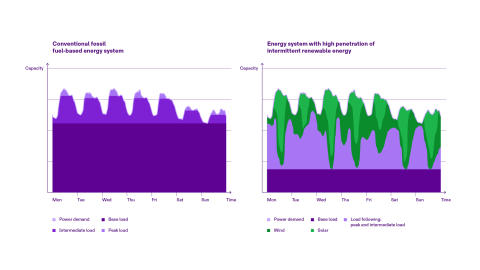
With the rise of renewable energy sources, the role of peakers has evolved. Traditionally, peaker plants were used to cover predictable periods of peak energy demand. However, as the energy system increasingly incorporates intermittent and non-dispatchable resources like solar and wind, there is a growing need for capacity that can respond on short notice. Renewable energy generation costs are usually low, so these sources are utilized to their maximum capacity. Consequently, fluctuations in supply have a greater impact than changes in demand.
Peaker plants: Catalysts for renewable energy integration
Modern peaker plants now need to follow supply changes to maintain grid balance, rather than just reacting to demand changes. This blurs the distinction between peaking and load-following plants. Today's peaking and load-following plants must operate at varying loads and for longer hours to manage the variability of renewable energy. They require faster response times and often integrate energy storage solutions to provide immediate power while gas turbines ramp up. Additionally, due to longer operation times, low emissions are increasingly important.
Benefits of Omterra peaker plant solutions
Discover advanced peaker plant solutions designed for today's energy needs. Gas turbines offer quick startups, fast ramp rates, low emissions, and scalable options, ensuring reliable energy and grid stability. Explore the benefits of Omterra high-efficiency peaker plants.

Short startup times
Ideal for multiple daily starts and stops.

High ramp rates
Quick response to changing power demands.

Excellent part-load capabilities
Efficient and emission-compliant operation even at lower loads.

Cost-effective
Low capital expenditure (CAPEX) with a good cost/performance ratio.

Rapid construction and installation
Short timelines for setup due to modularized design and pre-engineered solutions.

High efficiency
Superior simple-cycle (or open-cycle) efficiencies for low fuel consumption.

Low emissions
Minimal harmful emissions (NOX, CO, SO2, small particulates).

Low operational costs (OPEX)
High SC efficiencies for low fuel consumption; optional solutions for remote control or autonomous operation.
Additional options and offerings for peaker plants
Omterra offers a range of supporting solutions, such as battery storage systems for enhanced load-change response and black-start capability, remote control systems to reduce on-site personnel or autonomous plant operation, and hydrogen-capable turbines for low or zero emissions.
These plant solutions with an SSS clutch between the generator and the turbine allow the generator to act as a synchronous condenser during plant shutdowns, thereby enhancing grid stability. The plants are scalable for flexible power management and optimized efficiency. In the case of changing operating regimes, combined cycle upgrades utilize hot exhaust gases for additional power generation.
Qstor™ BESS
Provides immediate power and enhances load-change response. Reduces the need for the gas turbine to ramp up and down, which decreases mechanical stress on components, resulting in lower maintenance costs and longer equipment life. Stabilizes voltage and frequency during startup. Provides blackstart capability for rapid recovery in case of a blackout. Results in lower emissions.

Synchronous condenser operation
For grid stabilization, solutions with SSS (Synchro-Self-Shifting) clutch between gas turbine and generator are available.
The SSS clutch allows the generator to remain synchronized with the grid even when the gas turbine is not running, acting as a synchronous condenser (like a synchronous motor at no load). This ensures a fast response and provides reactive power and short-circuit power to the transmission grid. Additionally, a flywheel can be mounted to increase inertia, providing an extra spinning reserve for enhanced grid stability.

Omnivise T3000 control system
The Omnivise T3000 system enables centralized control of multiple remote units from a single control room. Operators can manage and monitor the plant from anywhere, reducing the need for on-site personnel.
Autonomous power plant solutions use AI-supported analysis, digital twins, and smart forecasts to optimize performance and minimize the need for manual intervention. Automated fault analysis and maintenance scheduling further reduce on-site personnel requirements.

Sustainable fuels
Omterra offers fuel-flexible gas turbines that can run on hydrogen, biofuels or HVO for power generation with low or zero greenhouse gas emissions.
Stricter carbon emission regulations will drive a shift towards low-carbon and zero-emission energy sources. H2-ready plants are prepared for conversion to hydrogen, ensuring they remain viable and profitable in a changing energy landscape, thus avoiding the risk of stranded assets.

Multi-unit installations
Omterra peaker solutions are easily expandable to meet growing demands. Multi-unit peaker installations allow for flexible power management and optimize efficiency by running turbines at maximum power when needed and starting up or shutting down units sequentially.
Enhanced overall plant reliability and availability: If one turbine requires maintenance, the remaining units can continue to operate.

Combined cycle power plant conversion
Simple cycle peaker plants can be upgraded to combined cycle if energy market requirements and operating regime change.
For steam tailing, a steam cycle with a heat recovery steam generator and a steam turbine is added to utilize the hot exhaust gases from the gas turbines for additional power generation. With our wide range of proven steam turbines, we can find the perfect match for your steam tailing project.

Gas turbines ideal for peaker plant use
8 MW gross power output
Up to 31.1% SC efficiency
Rapid startup: 3 min from startup (stand still) to full load.
High ramp rates: Gas turbine ramp-up rate of 50 MW/min.
Low load turndown: Gas turbine turndown to 46% minimum environmental load dependent on ambient conditions.
Highlights: Delivers ultra-fast 3-minute starts, high steam and heat raising for CC/CHP, robust fuel flexibility, and proven reliability from a mature fleet, making it a strong choice for seasonal and modular peaking concepts.
13 – 15 MW gross power output
Up to 36 % SC efficiency
Rapid startup: <5 min from startup (stand still) to full load.
High ramp rates: Gas turbine ramp-up rate of 24 MW/min.
Low load turndown: Gas turbine turndown to <30% at minimum environmental load dependent on ambient conditions with single digit NOx emissions.
Highlights: Combines best-in-class combined cycle efficiency, sub-5-minute fast start capability, and advanced decarbonization options, with high reliability and low emissions—perfect for load-following and modular peaking solutions.
34 – 39 MW gross power output
Up to 41 % SC efficiency
Rapid startup: 10 min from startup (stand still) to full load.
High ramp rates: Gas turbine ramp-up rates up to 82 MW/min for load-following and up to 21 MW/min for startup.
Low load turndown: Gas turbine turndown to 50% minimum environmental load dependent on ambient conditions.
Highlights: Offers the competitive start-up with high cyclic life in its class and with no hot lockout period, proven start reliability, availability, and reputation, highest simple cycle efficiency in its class, and exceptional operational flexibility, making it ideal for daily and flexible peaking.
45 – 62 MW gross power output
Up to 41.1% SC efficiency
Rapid startup: Only 10 min from startup (stand still) to full load.
High ramp rates: Gas turbine ramp-up rate of 12.5 MW/min.
High SC efficiencies: Up to 41.1% simple cycle (open cycle) efficiency.
Low load turndown: Gas turbine turndown to 40% minimum environmental load dependent on ambient conditions.
Low emissions: World-class emission performance over a wide load range with low NOx emission levels and single-digit CO emission levels.
Ideal for multi-unit peaker installations: Allows sequential startup or shutdown of units, ensuring flexible power management, optimized efficiency, and high plant availability.
Up to 385 MW gross power output
Up to 41.5% SC efficiency
Rapid startup: Only ≈13 minutes from turning gear to full load.
High ramp rates: Gas turbine ramp-up rates of up to 60 MW/min for load-following and up to 50 MW/min for startup.
High SC efficiency: Simple cycle (open cycle) efficiencies of up to 41.5%.
Low load turndown and good part-load efficiency: Gas turbine turndown to 30% minimum load for efficient and emission-compliant performance.
Increased power output for peaker applications: Higher power output can be achieved by injecting water into the gas turbine inlet (Wet Compression; WetC).
WetC improves turbine performance by reducing compressor inlet temperatures and increasing mass flow through the turbine.
260 MW gross power output
>40% SC efficiency
Rapid startup: Only 10 min from startup (turning gear) to 95% gas turbine load. There is a one minute coast in period from 95% load to base load.
High ramp rates: Gas turbine ramp-up rates of up to 52.4 MW/min for startup and load-following.
High SC efficiency: Simple cycle (open cycle) efficiencies of more than 40%.
Low load turndown and good part-load efficiency: Gas turbine turndown to 30% minimum load for efficient and emission-compliant performance using the optional Low Load Turn Down System, or to 50% emission-compliant gas turbine load without the Low Load Turn Down System.
Great fuel flexibility: Dual-fuel capability (gas/liquid) with rapid switching between fuels. Tolerates fuels within a wide Wobbe range and can fire up to 30% hydrogen.
Increased power output for peaker applications: Higher power output can be achieved by injecting water into the gas turbine inlet (Wet Compression or WetC).
WetC improves turbine performance by reducing compressor inlet temperatures and increasing mass flow through the turbine. (Note: This feature is not yet available for all SGT6-5000F gas turbine versions).
593 MW gross power output
>43% SC efficiency
Rapid startup: Only 12 min from startup (turning gear) to full load. World-class fast cold starts and hot-restarts due to the light and stiff rotor with internal cooling air passages.
High ramp rates: Gas turbine ramp-up rate of 85 MW/min.
High SC efficiency: Simple cycle (open cycle) efficiencies more than 43%.
Low load turndown: State-of-the-art combustion system allows gas turbine turndown to 30% minimum environmental load.
Short installation times: Proven and validated package and plant concepts the HL-class can easily be integrated in our power plants for simple cycle or combined cycle operation. This enables fast project execution.
Fast installation: Easy plant integration enables fast project execution. Modular, pre-engineered solutions reduce construction time and lower risks by minimizing on-site welding and construction complexity.
440 MW gross power output
>43.2% SC efficiency
Rapid startup: Only 10 min from startup (turning gear) to full load. World-class fast cold starts and hot-restarts due to the light and stiff rotor with internal cooling air passages.
High ramp rates: Gas turbine ramp-up rate of 85 MW/min.
High SC efficiency: Simple cycle (open cycle) efficiencies more than 43.2%.
Low load turndown: State-of-the-art combustion system allows gas turbine turndown to 30% minimum environmental load.
Short installation times: Proven and validated package and plant concepts the HL-class can easily be integrated in our power plants for simple cycle or combined cycle operation. This enables fast project execution.
Fast installation: Easy plant integration enables fast project execution. Modular, pre-engineered solutions reduce construction time and lower risks by minimizing on-site welding and construction complexity.
Get answers: FAQs on peaker plants
Peak load, or peak demand, refers to the highest level of power consumption by an electrical grid during a specific timeframe. Peak demand is the difference between the base demand and the highest demand within that period. It usually occurs during daytime hours when electricity demand is at its highest.
A peaking power plant, also known as peaker plant or simply "peaker," is a type of power plant that operates mainly during times of high electricity demand. These plants are dispatched alongside baseload and intermediate plants to handle surges in demand or periods when renewable energy supply is limited.
Peaker plants are essential for ensuring a reliable supply of electricity and maintaining grid stability during periods of high power demand or low supply from intermittent renewables. These plants can start up quickly and adjust their output to follow sudden changes in demand.
Peaker plants typically run for less than 2,000 hours per year, and often only a few hundred hours. These plants are designed to operate primarily during periods of high electricity demand or low supply from intermittent renewables, providing additional power to the grid when it is needed most.
Simple cycle (SC) plants, also known as open cycle plants, are used for peaking as they can start up quickly and adjust their output to meet sudden changes in electricity demand. In addition, SC plants have lower CAPEX compared to combined cycle (CC) plants. Given the low annual operating hours of peakers, the lower fuel costs of CC plants due to their higher efficiency cannot compensate for their higher CAPEX.
The most common fuel for gas turbine peakers is natural gas. However, if there is no gas infrastructure available, they can also use LNG or petroleum-derived liquid fuels such as diesel or fuel oil. Our gas turbines typically offer a dual-fuel (gas/liquid) option with the capability to switch fuels while operating.
For power generation with low greenhouse gas emissions, our gas turbines can (co-)fire hydrogen, biogas, and liquid biofuels such as biodiesel or HVO.
State-of-the-art gas turbine peakers produce only minimal harmful emissions, including nitrogen oxides (NOx), carbon monoxide (CO), sulfur dioxide (SO2), and small particulates. Exact emission levels depend on several factors such as the type of fuel used, the turbine combustion system, plant load, and other influences. Nevertheless, all our gas turbines and plants meet the world's most stringent emissions regulations.