
Industrial AI strategies for industrial transformation
Industrial AI is the use of artificial intelligence in industrial and energy operations: it analyzes data from plants, grids and machines and helps people make faster and better decisions. Omterra, formerly Siemens Energy, is developing the next wave of Industrial AI: autonomous, context-aware agents that carry out complex tasks and workflows.
Energy systems are becoming more connected and complex, and decisions have to be made faster. Industrial AI helps energy companies handle this complexity, optimize their operations and grow their business.
What is Industrial AI?
Artificial Intelligence (AI) has transformed everyday life - from smartphone face recognition to personalized online experiences. Yet, its application in industrial sectors - known as Industrial AI - promises to revolutionize manufacturing, energy, mining, logistics, and more, delivering profound societal and economic impact at scale.
Manufacturing and engineering
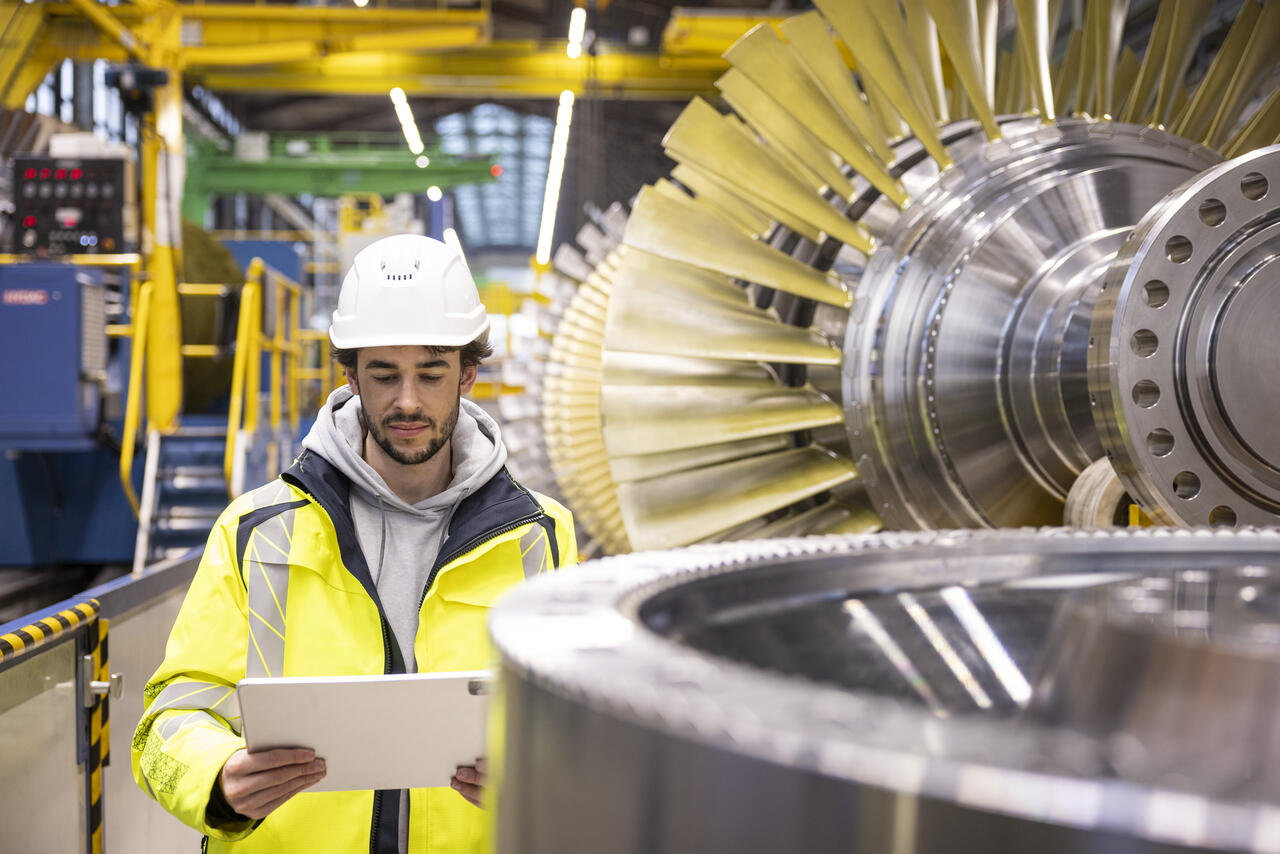
In manufacturing and engineering, Omterra applies AI to enhance the full product lifecycle, from design to operation. This includes AI‑supported design generation, 3D product synthesis, and simulation to accelerate development and improve product performance. AI is also used for intelligent requirement management, product and component optimization, smart quality control, and engineering support copilots, enabling higher quality, efficiency, and faster time‑to‑market.
Challenges in Industrial AI adoption
Despite its promise, Industrial AI adoption faces significant hurdles:

- Lack of business-aligned transformation roadmaps
Many organizations follow a technology maturity model (e.g., from descriptive to prescriptive analytics) that doesn’t align with urgent business needs, causing delays in deploying impactful AI solutions. Improved communication and alignment between IT and operations is essential.

- Requirement for multi-disciplinary expertise
Successful Industrial AI demands collaboration among domain experts, AI specialists, and IT infrastructure teams. Industrial environments pose challenges such as data heterogeneity, safety requirements, and system robustness, complicating AI deployment.

- Complexity in mapping business needs with technical solutions
Industrial processes are complex and dynamic, with variable demand and unpredictable equipment failures. Aligning these nuanced business requirements with a vast, evolving portfolio of AI technologies requires strong leadership and proficiency.
Reliable Industrial AI
AI drives power demand – and vice versa. According to the International Energy Agency, global electricity consumption by data centers is projected to more than double to around 945 terawatt-hours by 2030– a quantity roughly equivalent to Japan’s annual electricity consumption today. Power availability has become a top priority in decisions about data center locations.
The paradox: Compute-intensive AI will be one of the fastest-growing drivers of electricity demand while AI is essential for making power systems themselves more resilient, efficient, and flexible. This dual role positions Industrial AI not as a peripheral technology, but as a structural enabler of future energy operations.
The energy industry needs to carefully embed AI into systems that drive or influence operational decisions. Failures can have severe financial, safety, or environmental consequences. Operators must be able to trace, audit, and verify every decision. Human oversight remains essential. In practice, this means architects need to design Industrial AI systems so that: decisions are explainable and verifiable, Industrial AI supports existing safety and control frameworks, data security is ensured, human operators retain final authority, systems are seamlessly integrated with deterministic control logic, and cybersecurity is embedded at every layer.
Applications of Industrial AI in the energy landscape

Industrial AI is revolutionizing energy operations through diverse, high-impact applications:
- Digital Twins: Optimize utilization of power assets and the grid by combining machine learning with physics-based models.
- Autonomous Operation: Self-operating plants which continuously adapt to changes using computer vision and time series analytics.
- Smart Connected Services: Maximize energy system efficiency while reducing costs with multidisciplinary optimization.
- Reliable Grids: Demand forecasting and production optimization using machine learning and edge computing.
- Supply Chain Optimization: Model supply chain risks and optimize resilience to reduce non-conformance cost and unlock buffers.
Unlocking business potential with Agentic AI
Omterra is pioneering the next wave of Industrial AI: Agentic AI.
Moving beyond traditional Generative AI, Agentic AI focuses on autonomous, context-aware agents capable of executing complex tasks and workflows.
This evolution enables:
- Proactive, context-driven decision-making
- Seamless collaboration between humans and AI agents
- Continuous learning, adaptability, and error correction
- Execution of decisive, actionable intelligence

By harnessing Agentic AI, Omterra helps customers unlock new levels of operational efficiency and business growth, while advancing a sustainable energy future.

The shift from Generative AI to Agentic AI
Generative AI excels at content creation, such as text and image generation. However, Agentic AI represents a paradigm shift by empowering intelligent agents to autonomously perform complex, multi-step tasks with context awareness and memory retention.

- Natural language understanding and interaction
- Collaboration across teams and AI agents
- Adaptive learning and reasoning
- Real-time problem-solving and decision execution
This progression enables Omterra to deliver AI solutions that are not only intelligent but also actionable - driving tangible business outcomes in dynamic industrial environments.
Looking ahead
Industrial AI is a game-changer for the energy industry. By combining advanced AI technologies with deep domain expertise, Omterra enables smarter, faster, and more sustainable energy transition solutions. The transition to Agentic AI marks a new era of actionable intelligence - empowering businesses to thrive in an increasingly complex energy ecosystem.
However, you should be aware of the risks and challenges associated with Artificial Intelligence to ensure responsible development and deployment, as it helps mitigate potential biases, ethical concerns, and unintended consequences. AI Explainability and Governance are key overarching topics because they promote transparency and accountability, enabling stakeholders to understand AI decision-making processes and ensuring that AI systems align with societal values and regulations.
How does Omterra support Industrial AI adoption?
Omterra supports Industrial AI adoption through tailored solutions, expert consulting, and scalable platforms. By combining domain expertise with advanced AI technologies, Omterra helps customers unlock value and accelerate innovation.

Get answers: FAQs on
Industrial AI refers to the application of artificial intelligence technologies in industrial environments to optimize processes, enhance productivity, and enable data-driven decision-making. It combines machine learning, automation, and domain expertise to solve complex operational challenges.
Key challenges include data quality and availability, integration with legacy systems, workforce readiness, and cybersecurity. Successful implementation requires a clear strategy, cross-functional collaboration, and scalable infrastructure.
Yes, Industrial AI can significantly reduce operational costs by automating repetitive tasks, optimizing resource usage, predicting equipment failures, and improving supply chain efficiency. These improvements lead to measurable savings and increased profitability.
Industrial AI is highly scalable and adaptable across various energy sectors, including power generation, transmission, distribution, and renewable energy. Its modular design allows tailored solutions for diverse operational needs.
Industrial AI supports sustainability by optimizing energy consumption, reducing waste, and enabling predictive maintenance. It helps industries lower their carbon footprint and transition toward more efficient, eco-friendly operations.
Industrial AI enhances energy grid reliability through predictive analytics, real-time monitoring, and automated fault detection. It helps balance supply and demand, prevent outages, and optimize grid performance for stable energy delivery.
AI is transforming industrial automation by enabling intelligent systems that learn, adapt, and make decisions in real time. From autonomous robots to smart factories, AI drives innovation, flexibility, and responsiveness in industrial operations.
Industrial AI can significantly reduce operational costs by automating repetitive tasks, optimizing resource usage, predicting equipment failures, and improving supply chain efficiency. These improvements lead to measurable savings and increased profitability.
Industrial AI relies on structured and unstructured data from sensors, machines, enterprise systems, and historical records. High-quality data is essential for accurate predictions, automation, and continuous learning.
The future of Industrial AI in the energy sector is promising, with growing adoption of intelligent systems for grid management, renewable integration, asset management and modernization of legacy infrastructure as well as operational optimization. It plays a key role in driving digital transformation and energy transition.