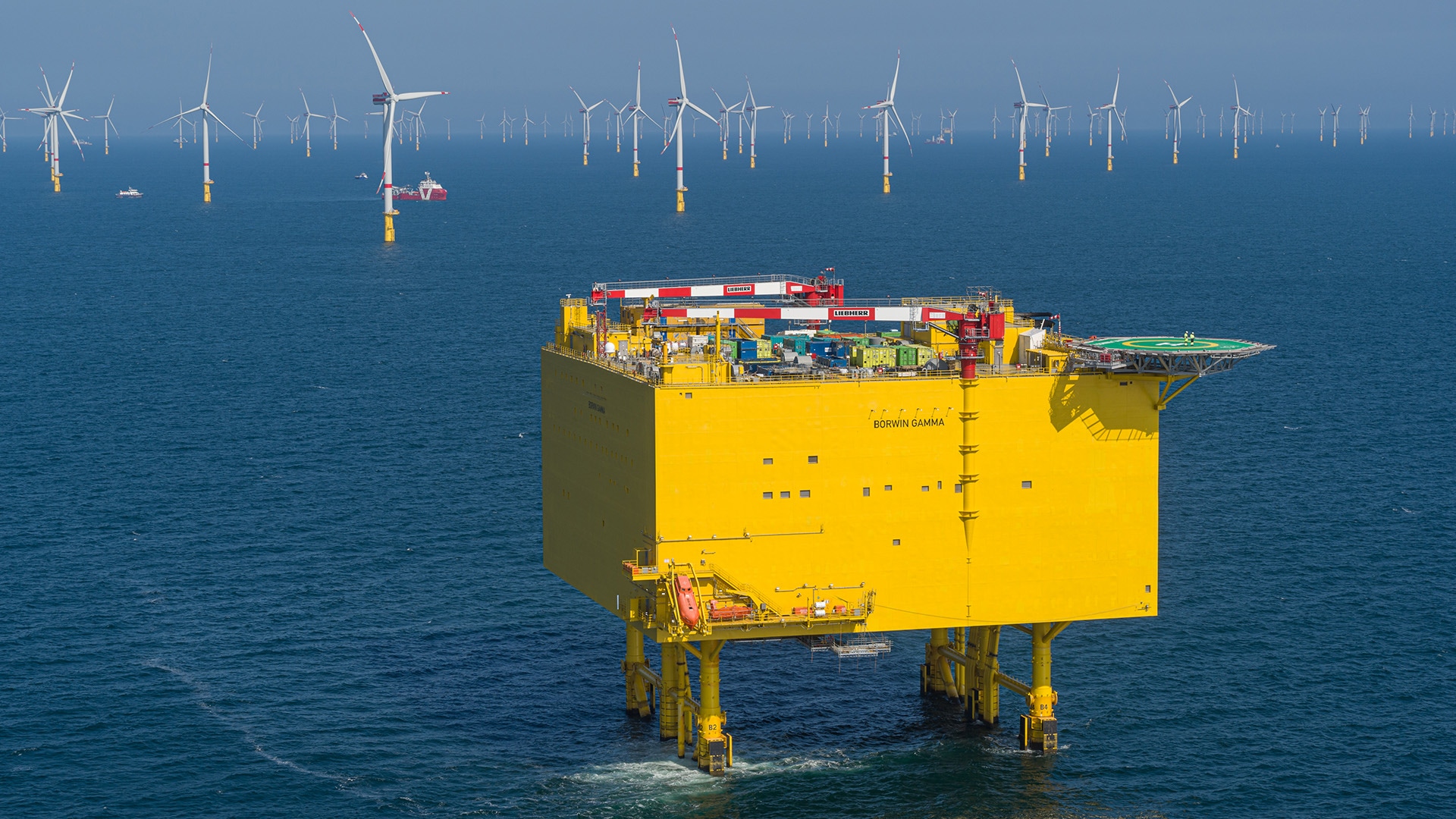
Offshore grid connections: HVDC and AC transmission from sea to shore
Offshore renewable energy projects are rapidly growing in scale and capacity, and offshore oil and gas installations are increasingly being electrified from shore instead of burning gas on the platform. Both need the exact same thing: a transmission link designed for long-term operation in demanding offshore conditions.
This offshore grid connection is the critical link between the marine installation and the onshore power grid. It consists of an AC offshore substation or HVDC converter platform that collects and transforms the power, the subsea export cables that carry it, and the onshore station that feeds it into the grid.
Omterra, formerly known as Siemens Energy, delivers these offshore grid connections in both HVAC and HVDC technology. Encompassing the electrical systems, offshore platform topside engineering, onshore stations, and lifecycle support, Omterra currently has 39 offshore grid connections delivered or under construction, totaling 35 GW by 2034.
What is an offshore grid connection and how does it work?
Every offshore connection solves the same problem – moving hundreds of megawatts to gigawatts of power across open water – with one of two technologies, chosen primarily by distance.
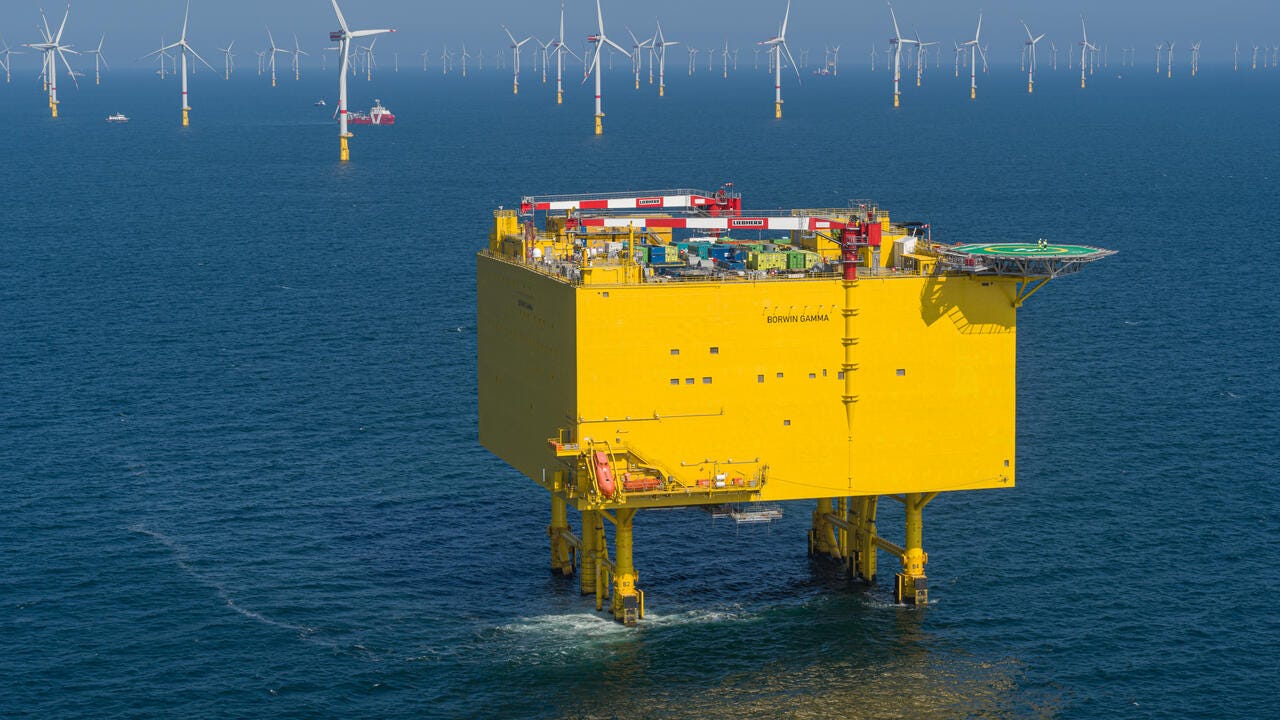
The components of an offshore grid connection
HVDC offshore grid connections for mid- and far-shore wind
HVDC connects far-shore wind farms efficiently to the grid. Omterra delivers turnkey offshore and onshore converter stations with HVDC PLUS® and compact DC switchgear. The latest generation: 2 GW, 525 kV bipole connections.
Offshore electrification: power from shore for oil and gas
Offshore oil and gas installations are increasingly powered from shore instead of by gas turbines on the platform. Omterra HVDC and HVAC power-from-shore solutions transport electricity from the onshore grid to the installation, cutting the platform’s CO₂ emissions and, depending on the project configuration, its fuel use and operating cost – proven in demanding offshore climates.
AC offshore grid connections for near- and mid-shore wind
AC offshore connections link wind farms to the grid over near- and mid-shore distances. They include the offshore AC substation – on a conventional platform or as a compact Offshore Transformer Module (OTM®) – the onshore substation, and the overall grid-code compliant system integration and engineering that ensures the system securely connects on to the grid and remains stable and reliable.
Floating substations for floating offshore wind
Floating offshore wind opens deeper waters with higher wind potential – and needs a substation that floats with it. Developed with industrial partners, Omterra floating substation concepts cover the range from small modular HVDC power-from-shore units and floating HVAC substations up to full-scale floating HVDC solutions above 1 GW. Clean Air gas-insulated switchgear, ester-insulated transformers, and closed cooling systems keep the environmental footprint of a floating offshore substation to a minimum.
Two of these four – the AC substation and the HVDC converter platform – are the offshore structures themselves.
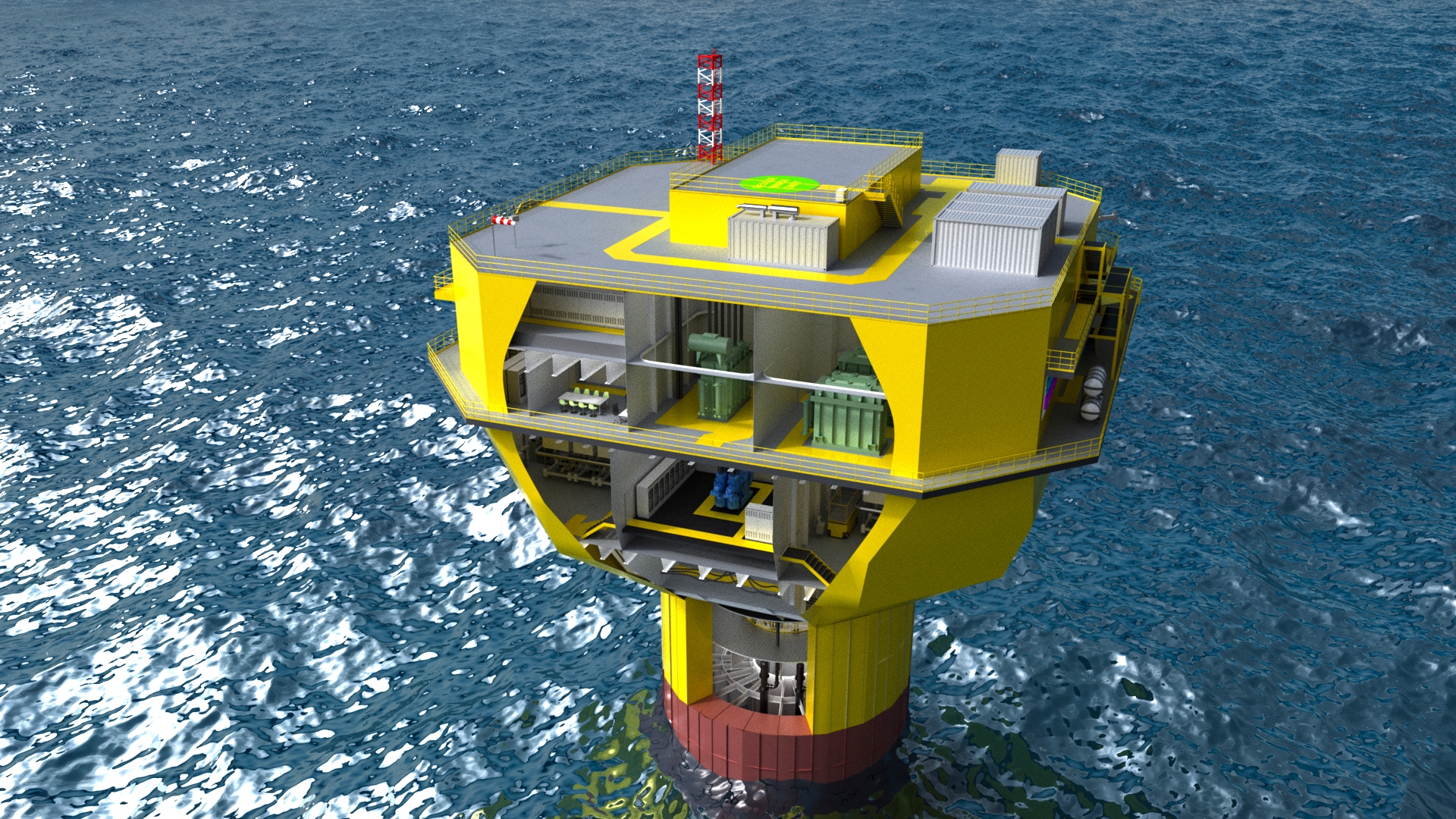
Offshore substations and converter platforms
The offshore substation is the heart of every connection: the structure at sea that collects the wind farm’s output, transforms it, and sends it ashore. Omterra supplies the electrical systems for both types.
AC offshore substations and the Offshore Transformer Module
A conventional AC offshore substation is a platform topside with transformers, gas-insulated switchgear, protection and control, and auxiliary systems, installed on a jacket foundation. For wind farms up to several hundred megawatts, the Omterra Offshore Transformer Module (OTM®) packages the same functions into a compact module installed on a monopile – the same foundation type as the turbines – which removes the jacket, the heavy-lift vessel, and months from the schedule.
HVDC converter platforms
An HVDC converter platform carries the HVDC PLUS® converter valves, converter transformers, reactors, cooling, and the DC switchyard. With gas-insulated DC switchgear the DC switchyard shrinks by up to 95 percent in a comparable reference configuration, which can make the platform itself up to 10 percent smaller. Omterra has delivered HVDC converter platforms in the North Sea since the first generation and is delivering the 2 GW, 525 kV generation now.
Comparison
| AC offshore substation | HVDC converter platform | |
|---|---|---|
| Typical application range (project-specific) | shorter-distance connections; the threshold depends on capacity, project design and timeline | longer distances and high-capacity links |
| Capacity per connection | hundreds of MW | up to 2 GW per platform in the current generation |
| Main equipment | transformers, GIS, protection and control | HVDC PLUS® converter, converter transformers, DC GIS |
| Structure | platform on jacket, or Offshore Transformer Module on monopile | platform on jacket floating concepts in development |
| Onshore end | AC substation | onshore converter station |
Both types share the engineering that makes them last: everything is designed for salt, motion and decades of operation without a service road.
Why offshore transmission is changing
Three things are changing at once. Wind farms are moving further from shore, into deeper water and larger lease areas, which pushes connections from AC to HVDC. Capacity per connection is rising – from a few hundred megawatts a decade ago to 2 GW standard connections today – which changes what a platform has to carry. And the onshore grid receiving this power is itself being transformed by renewables, so every offshore connection must also help maintain grid stability as synchronous generation declines.
That is why Omterra treats an offshore connection as part of the transmission system rather than as a cable with a platform on the end: HVDC PLUS® converters provide grid-forming capability and reactive power support, flexible AC transmission systems (FACTS) stabilize the onshore grid, and grid-code compliance is engineered in from the first design study. Digitalization adds monitoring and control across the whole link – and brings cybersecurity obligations for critical infrastructure that Omterra designs to from the start.
The economics have changed as well. Transmission cost is a decisive share of the levelized cost of energy (LCOE) of offshore wind – increasingly so as projects are tendered with little or no subsidy.
Omterra engineers the connection for LCOE from the outset – standardized 2 GW platforms, compact DC switchgear, monopile-mounted substations – while improving transmission reliability and grid-code compliance. The track record below is where that shows.
What Omterra delivers on every offshore grid connection
Four commitments apply to every connection, whether it is a 300 MW AC substation or a 2 GW HVDC platform:
Turnkey responsibility
Omterra takes turnkey responsibility for its scope – the electrical systems, platform topside engineering and onshore station – from pre-engineering through commissioning, to keep the project on time and on budget, and provides long-term maintenance where the operator wants it.

Proven technology
The HVDC PLUS® converter, the gas-insulated switchgear and the transformers on an offshore platform are technologies with established onshore operating experience – adapted for salt, motion and remote operation, and tailored to each connection.

Partnership over decades
An offshore connection is a multi-decade asset. Omterra supports it throughout its lifecycle – consulting on the next connection, servicing the installed one, and upgrading it as the grid around it changes.

Monitored performance
Advanced monitoring and control systems keep the connection’s performance in line with its design projections and identify opportunities to improve it. Which leads to the questions operators ask before they commit.

Get answers: FAQs on offshore grid connections
An offshore substation collects power from an offshore wind farm, transforms it to transmission voltage, and sends it to shore. In HVAC systems, this role is performed by an offshore AC substation. In HVDC systems, the equivalent offshore installation is an offshore converter platform, which converts AC power to DC for efficient long-distance transmission.
Mainly with distance and capacity. As the export route lengthens – often from roughly 90 to 110km, depending on capacity, cable configuration and project economics – AC export cables lose too much capacity to charging current and an HVDC connection becomes more economical; large capacities per connection also favor HVDC. Near- and mid-shore wind farms are normally connected with AC.
An offshore converter platform is the HVDC version of an offshore substation: a platform carrying the HVDC PLUS® converter, converter transformers, cooling, and the DC switchyard. With gas-insulated DC switchgear the switchyard needs up to 95 percent less space, making the platform up to 10 percent smaller.
Power from shore – offshore electrification – supplies an offshore oil and gas installation with electricity from the onshore grid through an HVDC or HVAC connection, instead of generating it on the platform with gas turbines. It cuts the installation’s CO₂ emissions and can reduce its operating cost.
A floating substation is an offshore substation on a floating structure rather than a fixed foundation, for floating wind farms in water too deep for jackets or monopiles. Omterra floating substation concepts range from modular HVDC power-from-shore units and floating HVAC substations to floating HVDC solutions above 1 GW.
For its scope, yes: Omterra takes responsibility from pre-engineering through commissioning for the electrical systems, platform topside engineering and onshore station, and offers long-term service. Subsea export cables are supplied and installed by cable contractors whose systems are type-tested against Siemens Energy’s interfaces.