Rotating Grid Stabilizer Conversion for grid stability
With the rising adoption of renewable energy, traditional power generation methods are utilized less, and generators are being shut down. Once these generators are shut down, their role in providing rotational inertia, short circuit power and voltage control, to help balance the grid system disappears with them also. Grid stability is, therefore, a vital consideration for transmission and distribution network operators, with increasing renewable penetration.
Omterra offers Rotating Grid Stabilizer (RGS) Conversion solutions leveraging the company's engineering expertise and service capabilities. The RGS Conversion comprises complete solutions for converting existing power plant equipment into synchronous condensers, from engineering to installation and commissioning.
What are the benefits of Rotating Grid Stabilizer Conversion (RGS)?
With the Rotating Grid Stabilizer (RGS) Conversion solutions, you can convert your existing power plant assets to a synchronous condenser to achieve grid stability. By utilizing power plants that may otherwise become stranded assets, RGS conversions provide necessary system inertia, short circuit power and reactive power to the grid for that balance.
Inherent frequency response, the result of system inertia, is the ability of an electrical machine to absorb and store or inject energy in order to manage frequency. One way to do this is to use technology with a rotating mass, like flywheels and synchronous condensers, to store energy for short-term frequency support. This helps to prevent blackouts, due to a rapid change of frequency and maintains a stable grid, within its frequency limits.
You can also generate additional revenue streams by providing additional active power with the hybrid conversion solution.
RATCH-Australia is adding a new revenue stream with a Hybrid RGS
How is grid stability maintained?
Traditionally, grid stability is achieved through the dependence on the system strength and system inertia. System strength refers to the ability of the electricity grid to recover intact from major disturbances and it is provided by the short-circuit power of the generator or synchronous condenser. The same generator also provides system inertia which is critical to maintaining a steady frequency in the grid. And no matter the source of generated power, electrical grid systems rely on both for grid security, safety, and reliability.
Supporting grid stability – free white paper
Ensuring grid stability is key to integrating more renewable energy. Download the new white paper to explore how thermal power plants can support grid stability.
Siemens Energy and Siemens Gamesa are now Omterra.
As the new brand is implemented progressively across our global operations, some existing company and product names, email addresses, and other identifiers may continue to appear during the transition.
Convert your generator to a Rotating Grid Stabilizer
The conversion approach at Omterra is tailored to meet your needs. Building new infrastructure is one option, but the infrastructure that is already in place can be repurposed as well. Typically, the project begins with a feasibility assessment to determine whether your assets can be converted to a Rotating Grid Stabilizer (RGS). The next step is to initiate a Front End Engineering Design (FEED) study in order to achieve a successful RGS conversion.
Basic RGS conversion
The basic conversion provides a cost-optimized solution that converts existing turbogenerators into synchronous condensers quickly. Omterra also takes care of installing a tailor-made solution for startup and accelerating the generator.
Flywheel conversion
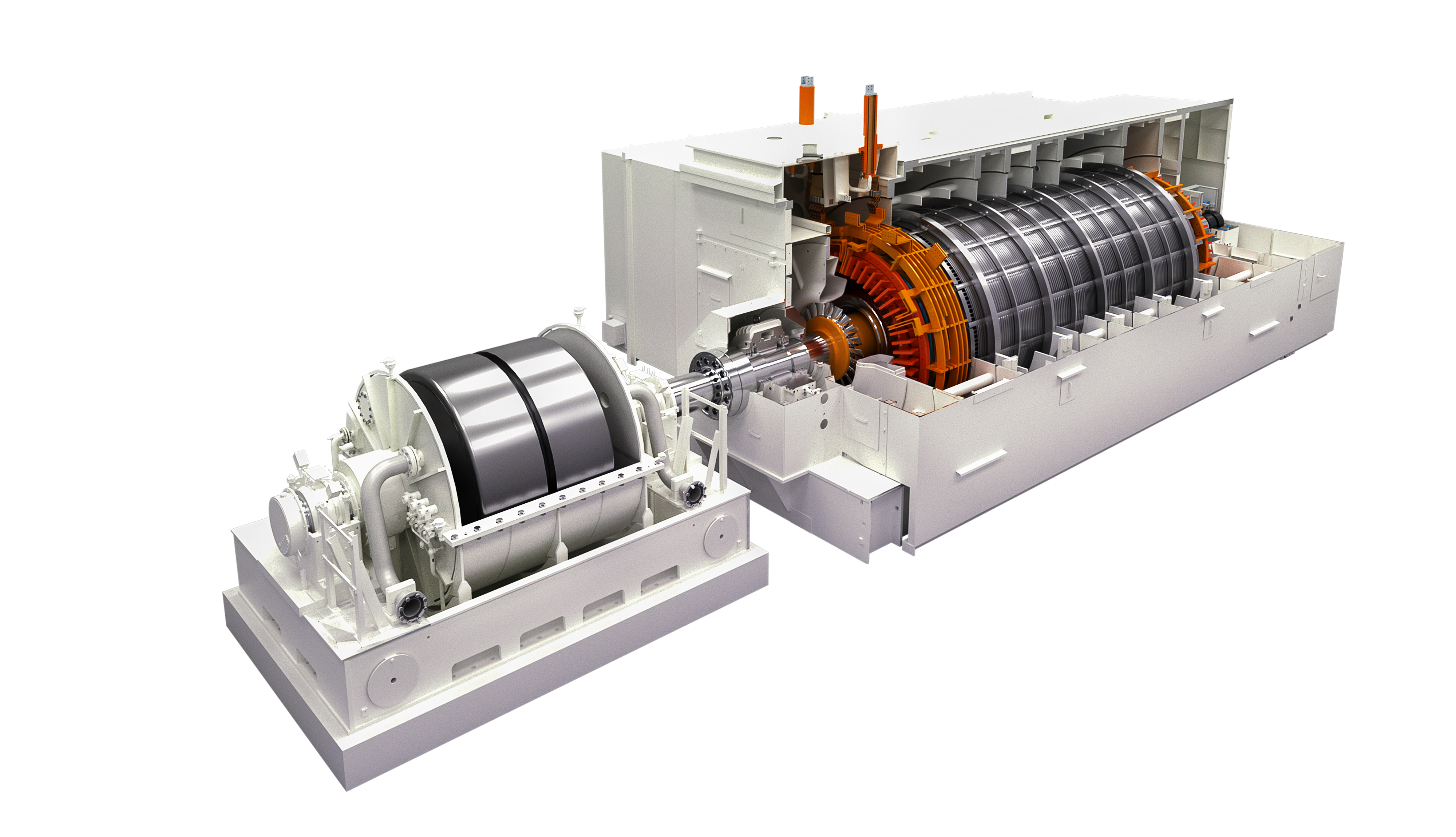
Generators can be extended with additional rotating mass from a flywheel to provide maximum inertia. Flywheels are operated in a partial vacuum and equipped with a cooling system to minimize friction losses and reduce cooling efforts.
Hybrid conversion
For maximum flexibility, you can couple a gas or steam turbine with an additional SSS (Synchro-Self-Shifting) clutch between the generator and the turbine. The option also exists to add additional inertia with a flywheel coupled to the existing shaft line.

Frequently asked questions
Grid stability is what keeps the challenges to power systems, such as the spikes or lulls in demand, power line, or even generator failure, in check. Since power is produced on demand, it's critical to ensure that the power system frequency and voltage remain within normal ranges. Maintaining this balance is necessary to keep the power grid stable and efficient.
To ensure the grid remains stable and secure, it is essential to balance the electricity grid through frequency stabilization, short circuit power, and voltage control. Flexibility stabilization happens when system inertia responds to sudden load imbalances. The inertia delays the Rate of Change of Frequency (RoCoF), so downstream grid stability controls can be executed.
Grid inertia is the ability of a power grid to absorb changes in frequency without destabilizing the system. It is the key factor for maintaining grid stability.
Short circuit power contribution is the ability of an electrical machine to inject high levels of current during a grid short circuit event, to ride through the fault and maintain a stable grid.
Voltage control is the ability to inject and absorb reactive power to ensure a stable system voltage. This helps to reduce the voltage drop caused by the short circuit, limit the short circuit current, and quickly restore the power system's stability. It also enables keeping the system voltage within an acceptable range.