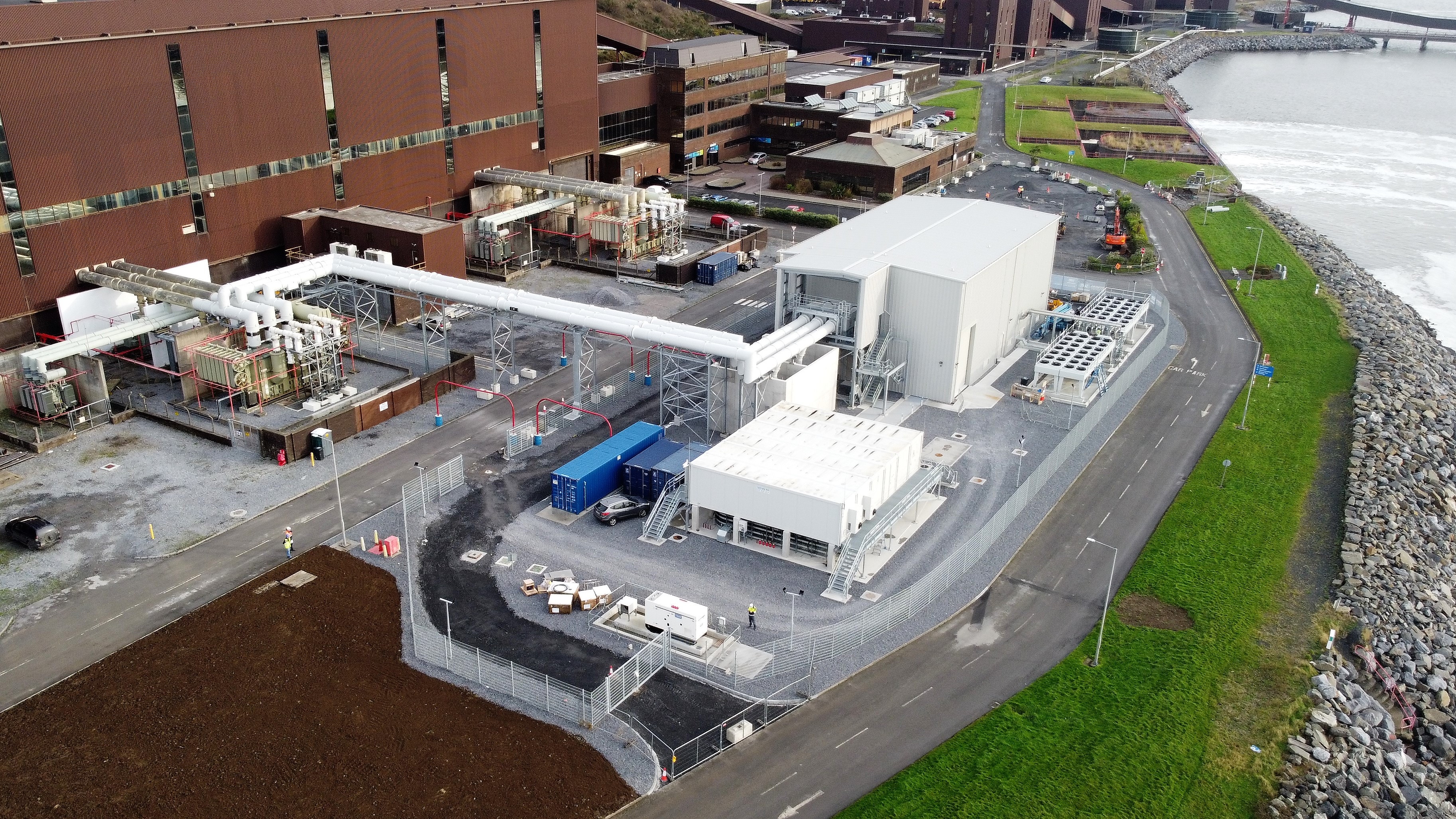
Synchronous condenser (SynCon)
Parallel connected synchronous condensers are mainly used for providing short-circuit power and inertia. They also help to stabilize the network through voltage recovery during faults. This becomes increasingly important with the rising share of renewable power generation that leads to a lack of short-circuit power and inertia.
Due to the fact that conventional power plants are shut down, synchronous condenser solutions use a conventional generator to provide the necessary inertia and short-circuit contribution by means of its rotating mass while also providing or absorbing reactive power.
Synchronous condensers: A proven solution for grid stabilization
A synchronous condenser provides short-circuit power, inertia, and reactive power for dynamic loads. Omterra, formerly known as Siemens Energy, supplies a broad range of generators up to 1,300 MVA at full speed.
Inertia and short-circuit power are key elements of grid stability – yet their availability is shrinking. This is caused by the addition of renewables-based power generation to the energy mix, phase-out of thermal power plants, new HVDC systems, and the extension of power supply systems to remote areas. All of this influences the stability of transmission networks, resulting in a worldwide renaissance of the synchronous condenser.
The Omterra synchronous condenser solution comprises a horizontal synchronous generator connected to the high-voltage transmission network via a step-up transformer. It is started up and stopped with a frequency-controlled electric motor (pony motor) or a starting frequency converter. When the generator has reached operating synchronous speed, it will be synchronized with the transmission network, and the machine is operated as a motor providing reactive and short-circuit power to the transmission network.
Contribution of short-circuit power
After the generator is synchronized with the network it behaves like a synchronous motor with no load, providing short-circuit power to the transmission network.
Voltage support
The generator is connected to the transmission network through a transformer. Either a pony motor or a static frequency converter starts it and provides reactive power when it’s synchronous to the system frequency.
Short-term overload capability
During emergencies or contingencies the synchronous condenser can provide a significantly higher rating for a short time, depending on its specifications.
Inertia to the transmission system
The generator provides the necessary inertia by means of its rotating mass while also providing or absorbing reactive power.
Synchronous condenser working principles
Omterra synchronous condenser solutions utilize a generator to provide the necessary inertia with its rotating mass while also offering or absorbing reactive power. The generator is connected to the transmission network via a transformer and is started by either an electric motor or a static frequency converter. Once operating speed is achieved, the generator synchronizes with the network, functioning like a synchronous motor with no load, thereby supplying reactive power and short-circuit power to the transmission network.
Maximum inertia with additional masses provided by flywheel solution
To provide maximum inertia, Omterra has extended the established synchronous condensers solution with additional rotating mass from a flywheel. This extension is a very effective method to maintain the required level of inertia and thus the RoCoF (Rate of change of frequency) of the system. Rotating mass provides an inherent synchronous inertia response (SIR), what is counteracting grid frequency fluctuations with active power injection or absorption during sudden load unbalance events.
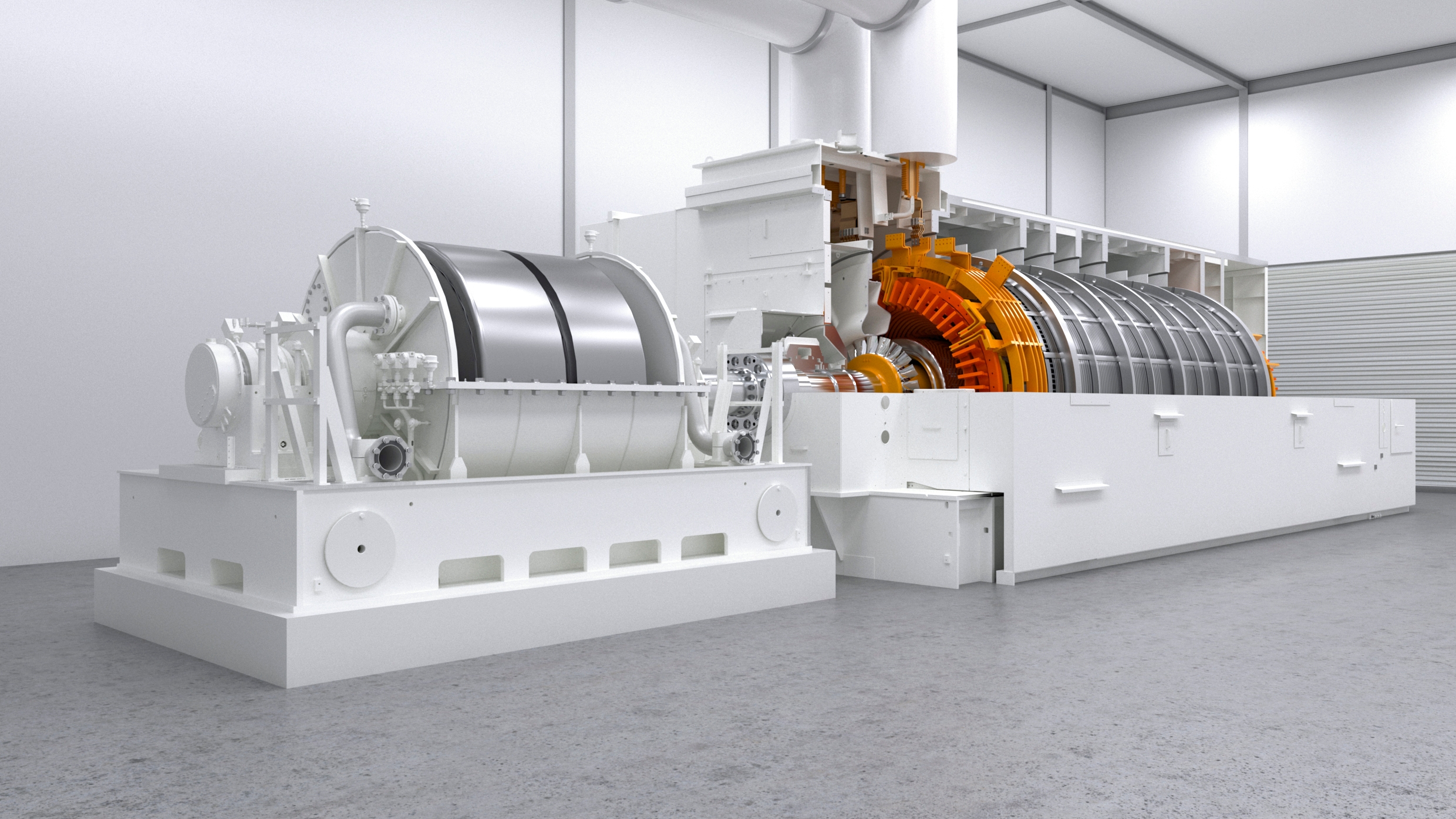
Omterra’s flywheels are operated in partial vacuum to minimize air friction losses and reduce the cooling efforts to maintain required temperature level in all operational and emergency modes. The design enables a safe emergency run-down in case of total power loss (grid black-out). The flywheel is designed for plug & play installation delivered to the site with rotor installed, lowest possible footprint and low supervision and maintenance effort.
Rotating grid stabilizer conversion
Synchronous condensers help to drive the decarbonization journey for power assets. With the rising adoption of renewable energy, traditional power generation methods are utilized less, and generators are being shut down. A brownfield rotating grid stabilizer conversion not only enables a rising share of renewable infeed on the grid but also provides a significantly reduced carbon footprint compared to a new build.
Synchronous condensers manufacturer
As a leading manufacturer of synchronous condensers, Omterra is committed to delivering innovative solutions that enhance grid stability and efficiency. The expertise in advanced engineering and technology allows Omterra to design and produce high-quality synchronous condensers tailored to meet the specific needs of power systems worldwide. With a focus on reliability and performance, the company supports the transition to renewable energy by providing essential reactive power and inertia, ensuring a robust and resilient electrical grid for the future.

Get answers: FAQs on synchronous condensers
Since power is produced on demand, it's critical to ensure that the power system frequency and voltage remain within rated ranges. Maintaining this balance is necessary to keep the power grid stable and efficient. In the worst case, to avoid blackouts.
A synchronous condenser is a large synchronous machine connected to the grid that doesn’t exchange mechanical energy during normal operation. Those machines operating solely to provide or absorb reactive power for voltage control and grid stability. In combination with the flywheel synchronous condenser provides high amount of inertia for the grid frequency stabilization too.
Capacitive or inductive reactive power is used to control the voltage in high voltage grids.
Short-circuit power contribution is the ability of an electrical machine to inject high levels of current during a grid short-circuit event, to ride through the fault and maintain a stable grid. The short-circuit power is also the enabler for stable protection function in electrical grids.
Grid inertia is the ability of a power grid to damp frequency oscillations without destabilizing the system. It is the key factor for maintaining grid frequency stability. To maintain a clean sinus function of the frequency, high inertia is more robust against frequency changes.
A synchronous condenser provides inherent short-circuit power and inertia as well as reactive power controlled by the control system.
Synchronous condensers are key enablers of the energy transition, as they enable a higher penetration of renewables in the power generation mix.
As renewable, non-synchronous power generation increases, conventional power plants are shut down. The inertia, short-circuit power and reactive power they used to provide will now be provided by the synchronous condenser, but more efficiently.
Synchronous condensers are installed in worldwide high voltage networks, with high renewable penetration.
For reactive power and short-circuit reasons, the choice or the perfect node in the network is crucial, whereas for inertia contribution installations, the location is more flexible.
Synchronous condensers can provide reactive power, short-circuit power and inertia more efficiently and economically than power plants when kept online for the sole purpose of grid stabilization.
If the inertia provided by the synchronous generator is not sufficient a fixed coupled flywheel can be added to increase the inertia contribution. With the addition of a flywheel, a synchronous condenser has an inertia constant similar to that of a large steam turbine.
Material strength limits the maximum size of flywheels. The largest flywheel can be up to a kinetic energy of approx. 3500 MWs in 50Hz and 2000MWs in 60 Hz.
Rotor dynamics of the rotating parts and flying forces are some of the challenges of modern flywheel technology. Using decades of experience in gas and steam turbine design by Omterra a safe design and manufacturing process for flywheels is ensured. Rotodynamic calculations are used for safe operation, vacuum and water cooled housings are used to reduce friction losses.