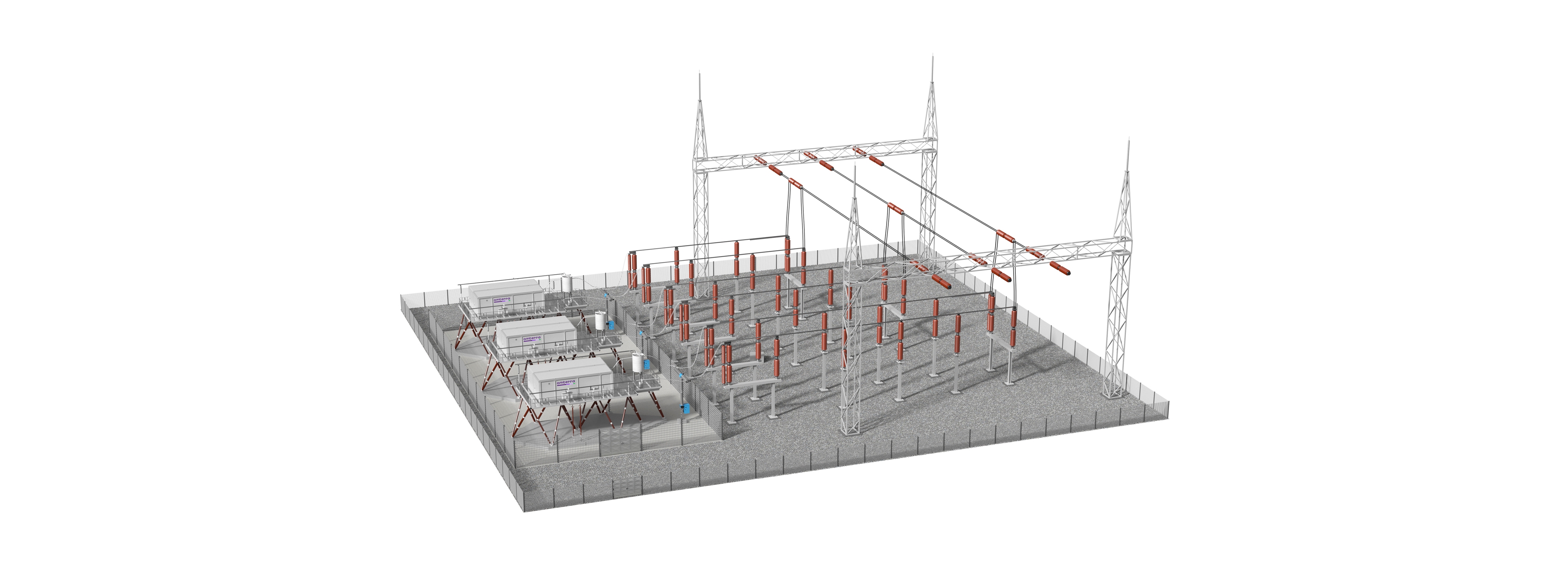
Converter controlled series capacitors (CCSC PLUS)
Converter controlled series capacitors (CCSC PLUS) provide dynamic series compensation and advanced power flow control for high-voltage AC transmission grids. CCSC PLUS is part of Omterra's Flexible AC Transmission Systems (FACTS) portfolio. It combines proven series capacitor technology with a converter branch – drawn from Omterra's SVC PLUS® and HVDC expertise – to deliver dynamic power flow control directly in series with the transmission line, with no high-voltage transformer required. The platform is designed for transmission corridors operating at up to 400 kV and line current ratings up to 4,000 A.
Why transmission grids need dynamic power flow control
Three forces are converging on transmission networks at the same time: demand is rising faster than new lines can be built, generation is moving further from load, and power flows are becoming harder to predict. The result is congestion on some circuits while parallel paths run below their thermal limit.
Growing demand is straining existing infrastructure. Transmission system operators (TSOs) are facing a sharp increase in electricity demand, driven by additional loads from data centers, the electrification of industrial processes, and EV charging. Much of this demand lands on infrastructure that was planned for a different load profile.
The construction of new power lines, or the refurbishment of existing ones, is very costly and time-consuming. Therefore, improving the utilization of existing infrastructure can help mitigate investment costs. Permitting, land rights and construction span years rather than months, so TSOs increasingly need to release capacity from the corridors they already own before committing to new build.
Uncontrolled power flows create congestion and cost
Congestion is no longer an occasional peak-hour event – it is a structural condition of networks carrying large volumes of variable generation:
- As more decentralized and renewable generation enters the grid, power flows become less predictable and harder to manage
- Thermal overloads on individual lines coexist with underutilized parallel paths – a structural inefficiency of conventional devices cannot be solved.
- Redispatch interventions are costly and becoming more frequent; TSOs need tools that manage congestion automatically and in real time.
The limits of conventional series compensation
Fixed Series Capacitors (FSC) and phase-shifting transformers (PST) remain key assets in modern grid infrastructure, but neither delivers fast dynamic series compensation: FSC impedance is set at commissioning and cannot respond to changing conditions, and a PST responds in seconds to minutes.
Thyristor controlled series compensation (TCSC) adds controllability, but injects harmonic content that requires filtering and offers only a limited inductive range.
A new class of grid enhancing technology is needed: one that combines the reliability of series capacitors with fast, converter-based control, and that stays cost-effective at the line ratings where modular series compensators become impractical.
What is CCSC PLUS?
CCSC PLUS is Omterra's platform-based solution for dynamic series compensation in AC transmission grids. It builds on the proven foundation of fixed series capacitor (FSC) technology – adding a converter branch in parallel with the capacitor bank to enable real-time, bidirectional impedance control, in both the capacitive and the inductive direction.
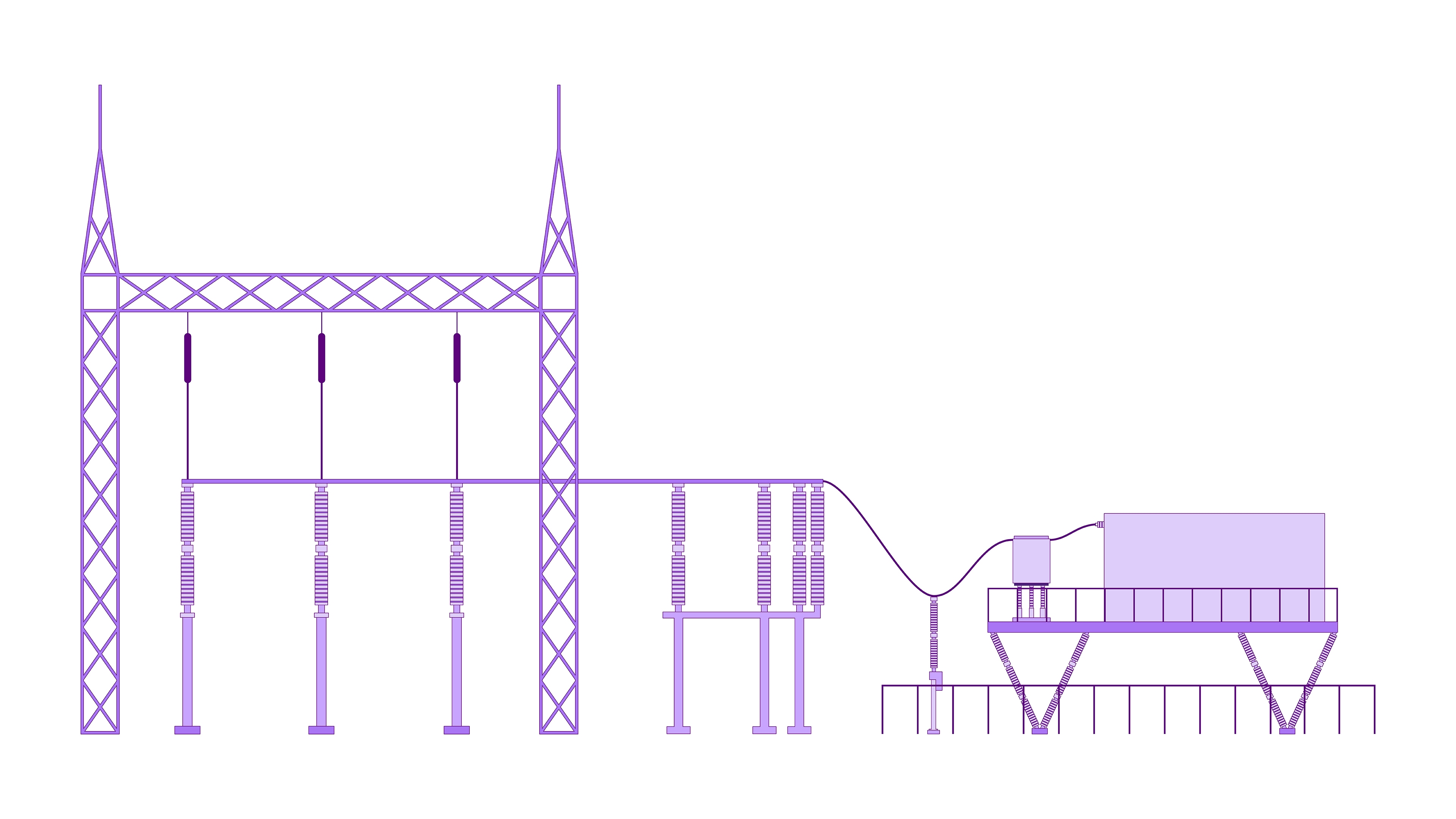
CCSC PLUS is the successor to the Unified Power Flow Controller (UPFC) concept. Where a UPFC required a high-voltage shunt transformer and a back-to-back converter arrangement, CCSC PLUS is installed directly in series with the line. Removing the transformer removes the single largest cost and footprint driver, while delivering comparable dynamic control capability.
Because no high-voltage transformer is required, CCSC PLUS offers a shorter lead time, a competitive installed cost and a smaller substation footprint than transformer-coupled alternatives – while providing full dynamic control capability.
Key positioning points:
- Part of Omterra's FACTS portfolio, alongside SVC PLUS® (STATCOM), SVC PLUS® FS (E-STATCOM), FSC, and Synchronous Condensers.
- Platform-based: benefits from containerized SVC PLUS® (Prefab) converter technology.
- Designed for line voltages up to 400 kV and line current ratings up to 4000 A (higher voltage available on request).
How CCSC PLUS works
CCSC PLUS combines two well-established Omterra building blocks on a single line-voltage platform: a series capacitor bank and a containerized voltage source converter. The sections below cover the system architecture, the two control modes, and the additional grid-support functions the converter branch enables.
System architecture: proven components, new combination
CCSC PLUS has two main elements installed on a single platform:
- Fixed capacitor branch: installed directly in series with the transmission line. Provides capacitive compensation via fixed impedance, increasing the power flow capability of the line.
- Converter branch (VSC): installed in parallel with the capacitor bank on the same platform. A containerized Voltage Source Converter (VSC) based on Modular Multilevel Converter (MMC) technology controls the voltage across the capacitor, dynamically adjusting the effective impedance seen by the line.
No high-voltage transformer is required. The platform design draws directly on Omterra’s FSC and containerized SVC PLUS® experience, both of which are in service in transmission networks worldwide.
Control modes
The converter branch enables two primary control modes:
- Impedance control mode: the system maintains a constant impedance setpoint regardless of changes in line current. This redistributes power flow between parallel transmission paths.
- Line current control mode: the system adjusts impedance compensation continuously to maintain a target line current setpoint, enabling precise power flow management.
Additional grid-support functions
Beyond steady-state power flow control, CCSC PLUS provides:
- Power Oscillation Damping (POD): an additional control loop acts against inter-area power oscillations, improving dynamic stability across the transmission corridor.
- Sub-synchronous resonance (SSR) mitigation: dynamic impedance control counteracts SSR and SSTI (sub-synchronous torsional interaction), which can damage generator shafts, as well as SSCI (sub-synchronous control interaction) between series compensation and inverter-based resources such as wind and solar plants.
- Emergency Dispatch: in N-1 fault scenarios (loss of a parallel line), the system can be commanded to maximize power flow on the remaining line, supporting grid resilience and N-1 security requirements.
- Line overload management: impedance adjustment redistributes flow away from thermally constrained circuits in real time, without operator intervention.
Use cases for CCSC PLUS
CCSC PLUS is applied wherever a transmission corridor is limited by how power distributes itself rather than by the physical rating of the conductors. The four scenarios below are the most common starting points for a system study.
Use case: Congestion management on parallel transmission corridors
Where two or more lines run in parallel, power flow naturally concentrates on the lower-impedance path – leaving the higher-impedance path underutilized. CCSC PLUS redistributes flow dynamically between parallel circuits, eliminating overloads without new infrastructure. This directly reduces redispatch frequency and cost.
Use case: Integrating renewables into constrained grids
Large offshore wind farms and solar hubs often connect into grid corridors with limited dynamic control capability. CCSC PLUS enables higher renewable penetration by redirecting power flows away from bottlenecks in real time, improving hosting capacity without line upgrades.
Use case: Grid stabilization and contingency response
- POD (Power oscillation damping): CCSC PLUS damps inter-area oscillations that can destabilize interconnected grids – a function critical as synchronous generation declines and grid inertia falls.
- SSR/SSTI (Sub-Synchronous Resonance / Sub-Synchronous Torsional Interaction) mitigation: Particularly relevant for grids with long radial lines and thermal generation, and for corridors with high shares of inverter-based generation, where sub-synchronous interactions pose a risk to generator shafts and to converter controls.
- Emergency dispatch after N-1 faults: Following the loss of a parallel line, CCSC PLUS can immediately maximize power transfer on the remaining circuit, maintaining supply security.
Use case: Deferring costly grid reinforcement
By extracting more capacity from existing lines, CCSC PLUS enables TSOs to defer or avoid capital-intensive grid reinforcement programs – delivering the economic case for grid enhancing technology investment at a fraction of the cost of new construction.
Benefits of CCSC PLUS for grid operators
The business case for CCSC PLUS differs by audience. Grid operations teams value the speed of response, planning teams value the deferred capital expenditure, and engineering teams value the smaller civil scope. The groups below summarise each.
For Transmission System Operators (TSOs)
- Maximize existing grid capacity without new line construction
- Reduce redispatch costs through automated, millisecond-speed power flow redistribution
- Improve N-1 security with emergency dispatch capability built into the control system
- Mitigate grid instabilities – POD and SSR mitigation in a single platform solution
- Defer capital expenditure – a fraction of the cost of new transmission infrastructure
For grid development and engineering teams
- No HV transformer required – smaller substation footprint, simpler civil works
- Platform-based design – factory-tested, site-assembled, reduced commissioning time
- Proven technology building blocks – VSC and MMC technology proven in Omterra's SVC PLUS® and HVDC projects worldwide
- Freely programmable control – MMC technology allows control modes and setpoints to be updated as grid conditions and grid codes evolve, without hardware modification
For energy transition objectives
- Enables higher penetration of renewable generation by removing transmission bottlenecks
- Supports grid decarbonization by deferring fossil-fueled redispatch
- Contributes to grid code N-1 compliance without new infrastructure
Technical specifications
The current CCSC PLUS platform covers the majority of high-voltage transmission applications. Applications above these ratings can be discussed with the Omterra engineering team.
| Parameter | Specification |
|---|---|
System voltage
|
Up to 400 kV (higher voltages on request)
|
Line current rating
|
Up to 4000 A
|
Impedance control
|
Capacitive and inductive (bidirectional)
|
Additional functions
|
POD, SSR/SSTI mitigation, Emergency dispatch, Line overload management
|
Converter technology
|
VSC / Modular Multilevel Converter (MMC)
|
HV transformer
|
Not required
|
Platform design
|
Containerized / site-assembled
|
Grid code compliance
|
N-1 security, power oscillation damping requirements
|
| Control system | Based on proven SVC PLUS® (STATCOM) control platform |
Engineering and project services
CCSC PLUS is supplied and supported across the full asset lifecycle, from the first system study through to control-software updates in service.
System studies and grid integration
- Load flow and stability studies for CCSC PLUS sizing and placement
- SSR/SSTI analysis for generator protection
- Grid code compliance studies and documentation support
- Validated simulation models for the common network planning and EMT platforms, so CCSC PLUS can be represented in your own load flow, stability and interconnection studies
Engineering, supply, and commissioning
- Full EPC scope available
- Factory acceptance testing (FAT) and site commissioning
- Integration with existing SCADA/EMS systems
Lifecycle support
- Remote monitoring and diagnostics
- Software and control updates (control mode optimization as grid conditions evolve)
- Spare parts and preventive maintenance programs
- 24/7 support – consistent with Omterra FACTS service standards

Get answers: FAQs on converter controlled series capacitors (CCSC PLUS)
CCSC PLUS is Omterra's platform-based dynamic series compensation solution for high-voltage AC transmission grids. It combines a fixed series capacitor with a converter branch based on voltage source converter (VSC) and modular multilevel converter (MMC) technology, providing real-time bidirectional impedance control and advanced power flow control without a high-voltage transformer. It belongs to Omterra's FACTS portfolio and replaces the UPFC concept with a simpler, more cost-competitive architecture.
A TCSC controls an inductor in parallel with a capacitor. CCSC PLUS uses an MMC-based voltage source converter, which injects a clean voltage with minimal harmonics and can operate in both the capacitive and the inductive direction – a wider and more flexible control range than TCSC.
Modular static synchronous series compensators perform well at moderate line ratings, but their per-phase module count makes them costly and physically large at high line currents. CCSC PLUS is designed for line ratings up to 4,000 A and delivers equivalent or better impedance control at those power levels, with a lower cost per unit of compensation and a smaller footprint.
Power oscillation damping (POD) suppresses inter-area electromechanical oscillations that can destabilize interconnected AC grids, a growing concern as synchronous generation is displaced by converter-interfaced renewables. CCSC PLUS includes a dedicated POD control loop that modulates series impedance in response to detected oscillations, improving transient stability without additional hardware.
Yes. SSR, SSTI (sub-synchronous torsional interaction) and SSCI (sub-synchronous control interaction) can cause mechanical damage to generator shafts and instability in inverter-based plants on series-compensated corridors. CCSC PLUS uses active dynamic impedance control to counteract sub-synchronous currents as an integrated function of the control system, removing the need for separate SSR filters.
CCSC PLUS includes an emergency dispatch mode that can be activated automatically or by the TSO on detection of an N-1 contingency, such as the loss of a parallel line. In this mode the system maximizes power flow on the remaining circuit within its thermal rating, maintaining supply security and reducing the risk of cascading outages.
Yes. CCSC PLUS sits within Omterra's Flexible AC Transmission Systems (FACTS) portfolio, alongside SVC PLUS® (STATCOM), SVC PLUS® FS (E-STATCOM), fixed series capacitors (FSC), synchronous condensers and mechanically switched capacitors (MSC/MSCDN). The converter technology is derived directly from the SVC PLUS® platform.
The current platform is designed for line voltages up to 400 kV and line current ratings up to 4,000 A, covering the majority of high-voltage transmission applications. Applications at higher line voltages can be discussed with the Omterra engineering team.