Dispatch Management
Power generation is no longer just about producing energy. It is about deciding when, how much, and at what price: in real time, across complex plant portfolios comprising various generation units.
Dispatch management connects generation assets, market access, and operational control in one coordinated approach. Omterra delivers this coordination for plant operators and energy traders, the teams who sell a plant's power and heat, across conventional, hybrid, and distributed assets in grid connected and island operation environments.


Optimize operations across every power generation setup
Power systems face competing pressures: Renewable input fluctuates, grid requirements tighten and market windows open and close within minutes. Combined heat and power plants can also shift output between electricity and heat, based on market prices. Dispatch management is the coordination framework from Omterra.
Omnivise Energy Management System (EMS)
Omnivise EMS combines weather, price, and load forecasts with asset availability to generate optimal dispatch schedules and setpoints, updating automatically as conditions change.
Generation Performance Management (GPM)
Generation Performance Management (GPM) turns flexibility into revenue through direct energy marketing, helping operators with complex, flexible fleets that provide ancillary services and frequency support. It handles market execution: distributing dispatch plans and setpoints, exchanging market messages, and keeping fleets aligned with TSOs and DSOs in real time.
Together, EMS and GPM give operators one coordinated approach, from planning to market execution. It keeps generation transparent and controllable, while enabling flexible responses to external signals.
In hybrid environments, dispatch management from Omterra works together with Omnivise Hybrid Control. This creates a consistent architecture across control, optimization, and market coordination.
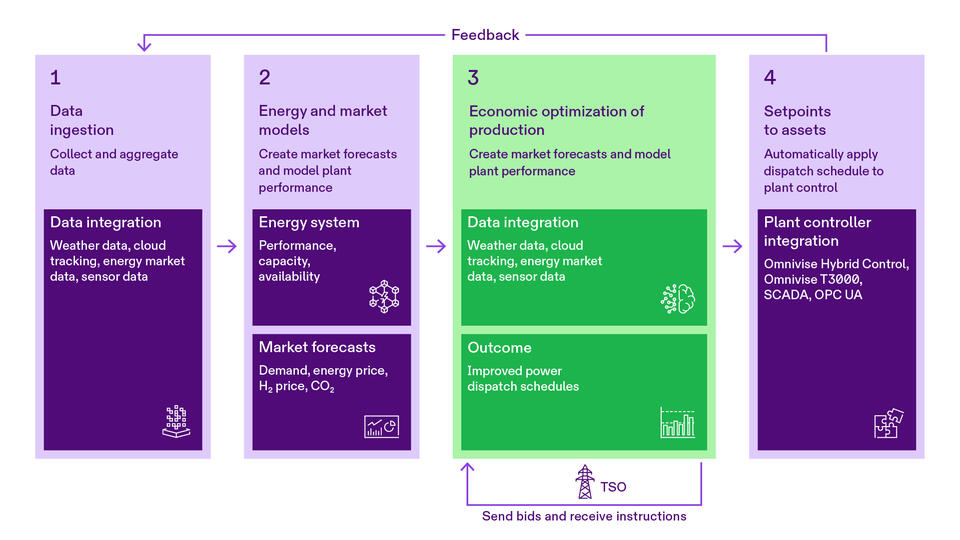
The dispatch management process at a glance
Turn generation assets into grid services
Generation assets can do more than produce power. With the right dispatch setup, they become active contributors to grid stability. Once a plant is technically qualified, dispatch management enables profitable participation in ancillary service markets – including balancing capacity and frequency support – depending on the applicable market design.
For plant operators, this creates additional revenue streams from existing assets. It also requires precise alignment between plant capability, dispatch logic, and market access. Dispatch management handles this alignment in one integrated approach.
Two use cases – one integrated approach
Dispatch management applies the same architecture to two fundamentally different operating environments.


Get answers: FAQs on
Asset and dispatch management is the coordinated planning, control, and optimization of power generation assets. It aligns maintenance, operations, commercial, and IT/OT teams around one operating plan.
Operators must weigh asset availability, grid conditions, maintenance windows, fuel costs, and market prices at the same time. Renewable growth adds further variability. Dispatch management consolidates these signals into one real-time decision.
Dispatch management sets the operating schedule and setpoints plants follow. It determines when assets run, at what output, and how they respond to grid signals, market prices, and maintenance constraints.
Ancillary services are grid-support functions, such as frequency response and balancing capacity, delivered by qualified generation assets to transmission and distribution system operators (TSO/DSO). Dispatch management enables profitable participation in these markets.
Combined heat and power plants can shift output between electricity and heat depending on market prices. Dispatch management supports this trade-off alongside standard power dispatch.
What's next? Let's connect!
Dispatch management affects fleet performance, revenue potential, and operational resilience. Omterra works with operators to define the right setup for their specific plants and portfolios