
Omnivise Energy Management System
Energy and capacity markets shift by the hour, and every generation decision affects revenue. Operators need to plan ahead, anticipate market and grid conditions, and act fast. Without a coordinated system, available capacity goes unused, or power is sold at the wrong time.
Omnivise Energy Management System (EMS) from Omterra optimizes how power generation assets are scheduled and dispatched, independent of the generation type.
At its core, a dispatch-optimization module continuously calculates the economically optimal generation schedule. It turns that schedule into setpoints, which plant controllers execute directly. Taking grid signals, market prices, weather conditions and capacity obligations into account, it optimizes the scheduling and dispatch of electricity generation resources to meet demand at the lowest possible cost.
The outcome: more revenue across electricity, ancillary service, and hydrogen markets, a lower carbon footprint, and near-instant response to changing demand or grid conditions.
For hybrid power plants, for example, Omnivise EMS works together with a plant controller such as Omnivise Hybrid Controller to form a complete energy management stack.
Omnivise EMS for multi-asset power generation

Omnivise Energy Management System helps operators unlock the full profitability of their generation assets, even in volatile markets. Drawing on price signals, asset availability, and weather data, it continuously calculates a detailed, asset-specific generation plan that re-optimizes itself as new information arrives. It sends the resulting setpoints to the plant controller, which executes them in real time.
Omnivise EMS is built for operators who run more than one generation asset, such as combined cycle, thermal, hybrid, or power-to-X plants. It works as a standalone system, and for hybrid power plants it pairs with a controller like Omnivise Hybrid Controller to plan ahead and execute in real time.
Key facts of Omnivise Energy Management System:
- Dispatch and generation optimization: a mathematical solver builds the economically optimal power generation schedule across all connected assets, based on market and operational data
- Integrated forecasting: forecasts of production, demand, and market prices feed the optimization
- Continuous re-optimization: the generation plan updates automatically as conditions change and new information arrives
- Built on Omterra expertise: developed by the engineers who build and service the generating assets, using industrial AI
- Certified cybersecurity: according to IEC 62443-1 and IEC 62443-3-3
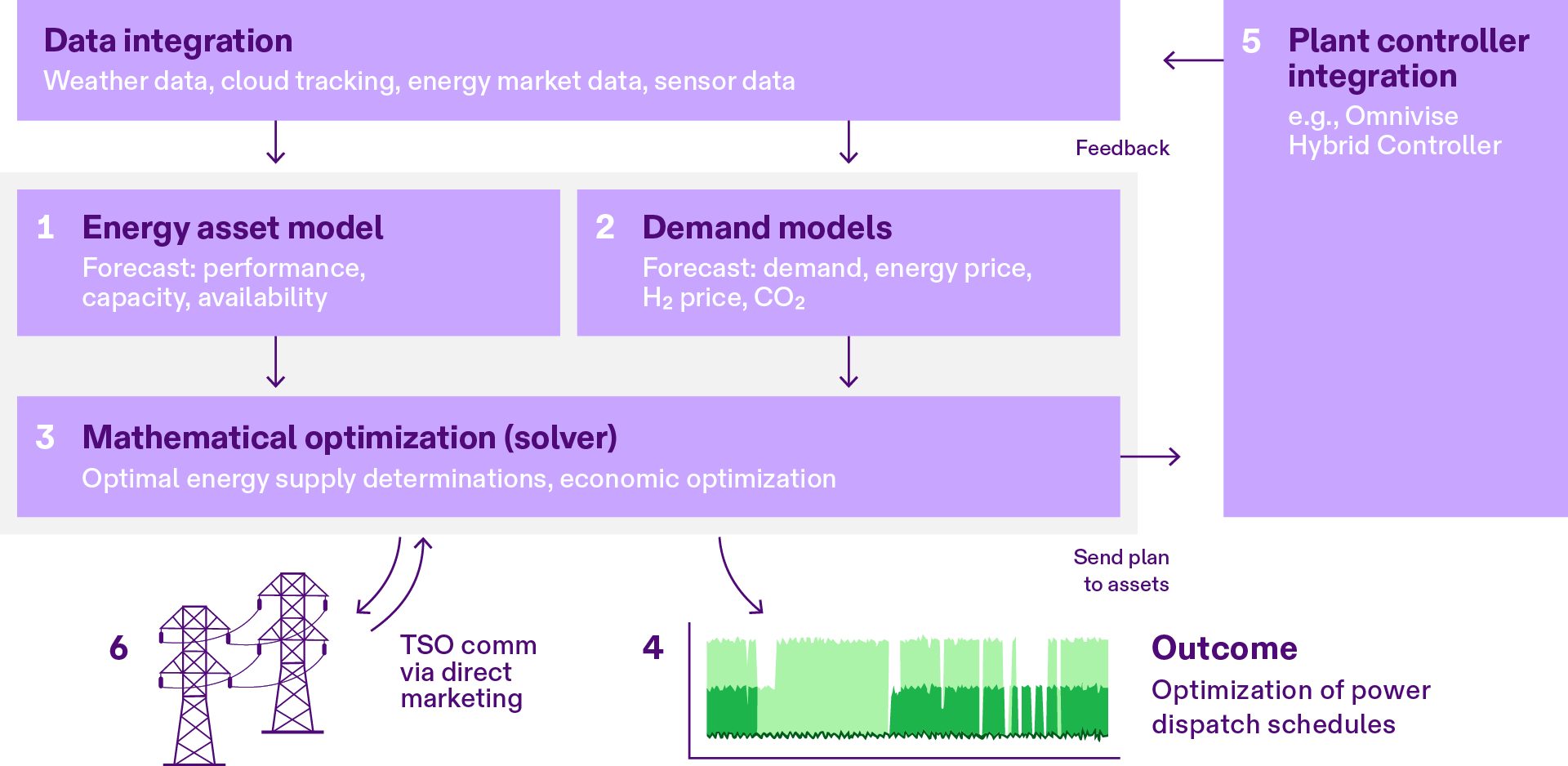
From live data to optimized dispatch


Omnivise EMS covers the full path from data to optimized dispatch. It considers weather data, market prices, sensor readings, and planned outages, builds accurate forecasts, and runs mathematical optimization to determine the optimal generation schedule.
This optimization is continuous, not a one-time step: it keeps incorporating new information, including feedback from the transmission system operator (TSO). The resulting setpoints then go to the plant controller for execution, and Omnivise EMS re-optimizes as conditions change.
How Omnivise Energy Management System works
Collect data
Omnivise EMS continuously ingests weather data, market prices, sensor signals, and plant availability.
Forecast and model
Asset models turn this data into accurate forecasts of performance, capacity, demand, and prices for each connected asset.
Optimize and schedule
A mathematical solver builds the economically optimal generation plan. It runs continuously and incorporates new information, including TSO feedback. The resulting schedules are communicated to the TSO and energy markets (day-ahead, intraday, balancing, and ancillary services), together with Generation Performance Monitoring (GPM).
Apply to plant control
The optimized setpoints go automatically to the plant controller for real-time execution.
Key benefits of Omnivise EMS
- Optimal asset deployment - Omnivise EMS puts the available generation assets to their most economical use: meeting a required output at the lowest cost, or maximizing output and revenue.
- Revenue optimization - Omnivise EMS identifies the highest-value dispatch option at each point in time – whether that is the spot market, a balancing service, or storage release during peak demand periods.
- Weather-independent operations - Forecasting models decouple operational planning from weather uncertainty. Operators act on predictions rather than reacting to conditions. This reduces curtailment and improves capacity factor.
- Scalable multi-asset management - Omnivise EMS scales from a single plant to multi-site portfolios. It connects to all major asset types – Hybrid power plants, combined cycle power plants, Power-to-X, thermal power plants and steam power plants – through a unified interface.



Get answers: FAQs on Omnivise Energy Management System
An energy management system in power generation enables the optimized dispatch of multiple energy assets, reduces costs, and maximizes revenue. Omterra's Omnivise Energy Management System (EMS) does this through forecasting and mathematical optimization across the plant's generation and storage assets.
Omnivise EMS combines weather forecasts, energy price predictions, and CO₂ projections to calculate the optimal dispatch strategy at each point in time. It determines when to generate, store, or trade energy to maximize the overall remuneration scheme – while staying within operational and regulatory limits.
Yes. Omnivise Energy Management System (EMS) is designed for scalability. It connects to diverse asset types across multiple locations and manages them within a single optimized dispatch framework. This makes it suitable for operators expanding their renewable portfolio across different technologies and geographies.