
Predictive Emissions Monitoring System (PEMS) for industrial and aeroderivative gas turbines
PEMS is a permanent, cost effective and compliant solution
With growing focus on decarbonization and clean energy, it is essential for plant operators to monitor and record emissions data to demonstrate regulatory compliance. Monitoring options range from temporary expert-led setups to permanent systems. Due to frequent reporting requirements, many operators are opting for cost-effective, permanent solutions. Omterra is offering the Predictive Emissions Monitoring System as solution for emissions reporting requirements.
Gain insights into your equipment to reduce emissions
Measure
Calculate
Emissions prediction
Report
Predictive Emissions Monitoring System (PEMS) is the next level of emission monitoring in a cost effective and regulatory compliant manner. Compared to the traditional Continuous Emissions Monitoring System (CEMS), PEMS do not use hardware-based sensors to measure emissions. PEMS is a digital solution, taking engine operational data and feeding through a unique set of algorithms, determining the emissions signature of the engine. The predictive emission monitoring system is applicable for all industrial and aeroderivative gas turbines.
PEMS provides an unique OEM experience, allowing operators to significantly reduce the CAPEX and OPEX of emissions measurement activities. PEMS can be operated as redundant systems next to CEMS or as standalone certified systems without CEMS.
PEMS evaluates emissions in accordance with international standards like US EPA Part 40 CFR 60 PS 16, and CEN TS 17198.
Intended benefits

Emissions calculations with no additional equipment or requirements.

Significant reduction in operational and maintenance costs compared to CEMS.
Combined lower CAPEX and OPEX (estimated 50 to 80 percent) compared to CEMS over a comparable lifecycle.

Our PEMS solution can work with highly contaminated fuel gases and environmental conditions, because it is a digitalized solution; there is also no costly SIL/ATEX compliance.

PEMS can also be used by the customer and by Omterra for more rapid identification of performance issues using PEMS data.
Service support & implementation
- With algorithms embedded within our known cloud platforms ‘Omnivise Cloud Platform’, data received via remote connection.
- Integrated within our known digital frontend platforms ‘MyHealth’ or ‘Omnivise’; therefore, providing data and the ability to analyze data straight to your chosen device.
- Optional: Omterra offers facilitation in the certification process.
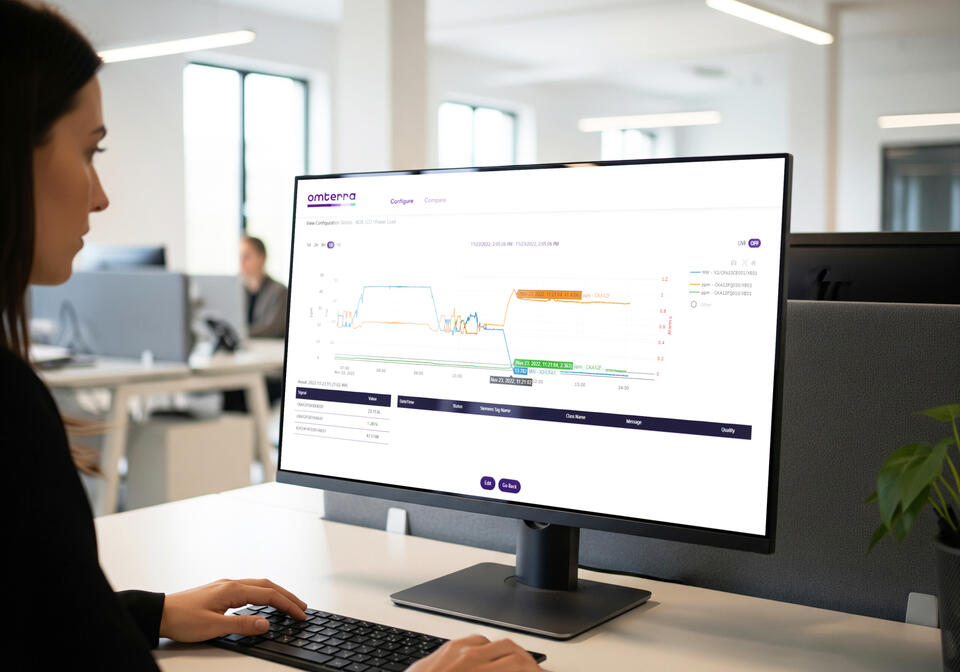
- DCS-embedded: The algorithm can be embedded into the main turbine control system software e.g. PCS7, Allen-Bradley™ or Omnivise T3000.
- Emission data will be displayed in high resolution real-time directly on the Human-Machine-Interface (HMI); minor activities on site required.
- Only available for OGT-600/700/750/800 fleet.

Get answers: FAQs on Predictive Emission Monitoring System (PEMS)
A Predictive Emissions Monitoring System (PEMS) leverages advanced algorithms and real-time operating parameters to predict engine emissions, providing reliable, continuous monitoring with reduced hardware requirements, lower maintenance costs, and greater operational flexibility.
PEMS is a software tool that collects engine operational data and processes it through specialized algorithms to calculate the engine’s emissions signature.
A Continuous Emissions Monitoring System (CEMS) directly measures emissions using physical analyzers and sampling equipment installed in the exhaust stream, requiring extensive instrumentation, regular maintenance, and periodic calibration. In contrast, a Predictive Emissions Monitoring System (PEMS) uses advanced algorithms and real-time operating data to accurately calculate emissions without relying on dedicated measurement hardware. By minimizing analyzer maintenance, reducing operating costs, and eliminating many of the challenges associated with physical sensors, PEMS provides a reliable, scalable, and cost-effective alternative for continuous emissions compliance and performance optimization.
PEMS offers significantly reduced capital and operational expenditures and provides reliable, user-friendly operation in harsh environments. It can run as a standalone or backup system, supported by Omterra OEM expertise and extensive test data.
PEMS is primarily software-based: it uses engine data as inputs and does not require physical sensors or expensive site equipment like CEMS.
PEMS software is a set of specialized algorithms and thermodynamic models that take in engine data and provide accurate digital emission calculations, without additional hardware installations.
Yes, PEMS can work standalone or alongside CEMS, and may be integrated into plant control systems for streamlined operation and data management.
PEMS is used globally in industries where cost-effective, reliable, and compliant emission reporting is required, particularly where continuous physical sensor operation would be costly or impractical.
PEMS reliability is supported by extensive factory test data and Omterra thermodynamic expertise, providing ultimate confidence in emission modeling accuracy.
Yes, since PEMS is a software tool and does not rely on physical sensors, it operates effectively even in highly contaminated and tough environmental conditions.
Operators can expect 50-80% lower CAPEX and OPEX compared to traditional CEMS over the system’s lifecycle.
No, PEMS is designed to be user-friendly and does not require operators to have specialized training or skills.
Yes, PEMS can assist both customers and Omterra in identifying engine performance issues through fault finding and analysis using emissions data.