The ferry making waves - without making noise
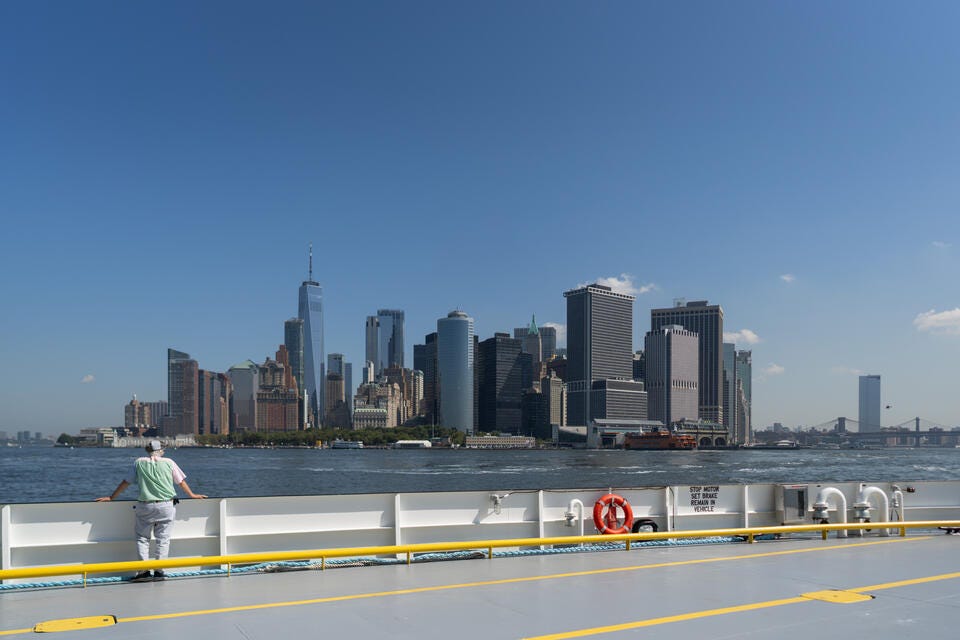
In the New York Bay, between Brooklyn and Manhattan, lies Governors Island, long a strategic outpost for the U.S. military. The Coast Guard later ran a small service town there until the early 2000s, when advances in aerial surveillance made the base obsolete. The federal government handed the island over to New York City in 2005.
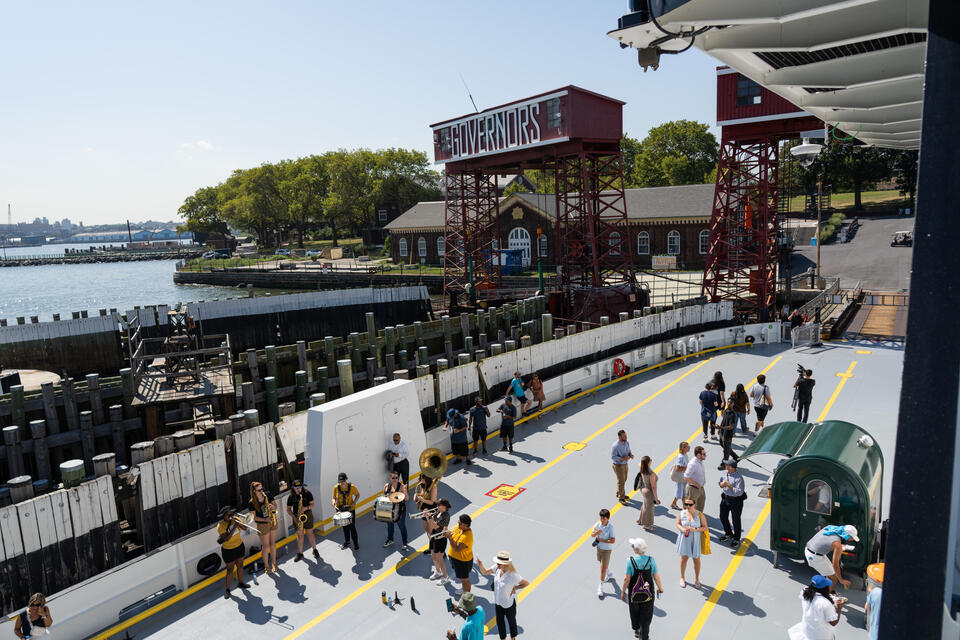
The city quickly seized the opportunity, creating a public-benefit trust that opened Governors Island to New Yorkers and tourists as a car-free refuge - a place for strolling, art, education, and increasingly, climate research. Today, the island hosts a growing climate-science campus, sweeping green spaces, playgrounds, and even waterfront concerts set against the dramatic skyline of Lower Manhattan.
The journey is the reward
Edward Schwarz, Head of Marine Energy Solutions Sales for the United States and Canada at Omterra, likens the island to Manhattan’s “green lung,” Central Park. “You feel like you’re standing somewhere untouched - and the skyscrapers are right there, almost within reach,” he says.
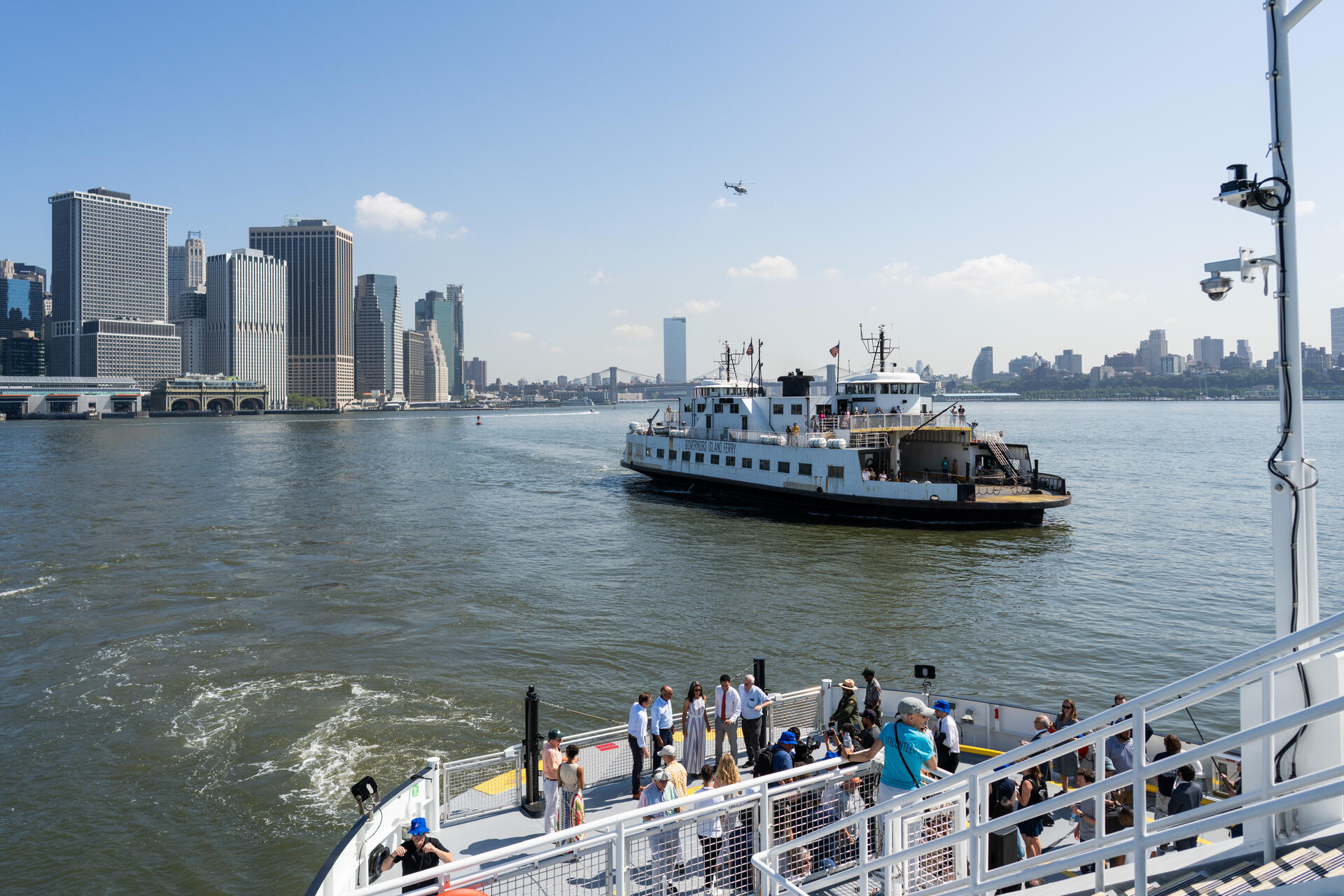
The newest attraction when visiting Governors Island, however, isn’t the island itself, but the way you get there: the Harbor Charger, the very first ferry in New York State that can operate electrically. It transports visitors to the island without CO₂ emissions - almost twice as fast as its predecessors, and quietly, without engine noise or vibration, all for the price of a subway ride.
“Ferries are the only transportation link to Governors Island - the island’s lifeline,” Schwarz explains. However, the existing vessels had aged: the Harbor Charger replaces the diesel-powered Lt. Samuel S. Coursen, commissioned by the U.S. Army in 1956 and in continuous service for nearly seven decades.
Ready for a fully electric future
The city’s trust wanted a replacement that would credibly reflect the island’s ecological vision. They contracted Omterra to develop the lowest-emission propulsion system possible. Working alongside the design firm Elliot Bay Design Group and the Conrad Shipyard in Morgan City, Louisiana, Omterra built a ferry ready for a fully electric future.
The engineering centers on three main components:
- BlueDrive Eco diesel-electric propulsion—enabling flexible operation in three modes: emission-free battery-only, efficient hybrid (battery plus diesel backup), and pure diesel if needed.
- BlueVault energy storage system—advanced batteries manufactured in Trondheim, Norway, for robust power and long operational range.
- EcoMAIN digital platform—real-time monitoring and effortless management of all onboard systems.
Taking the controller instead of the wheel
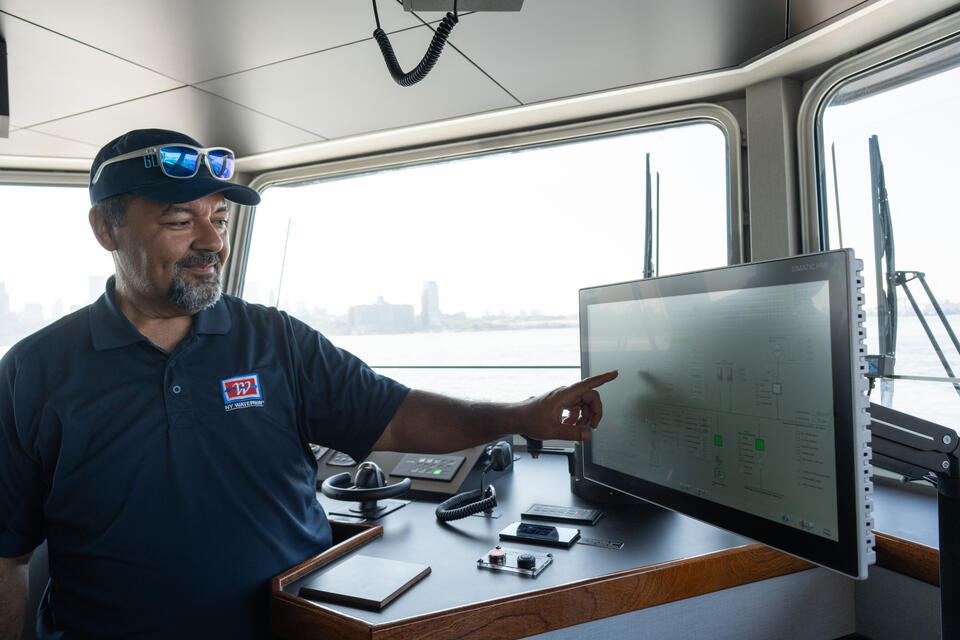
The system is essentialy digitally controlled; many processes run without manual intervention. A single person can start the entire operation within minutes—a striking difference from conventional, diesel-oriented setups.
Instead of a traditional wheel, the captain uses a controller that resembles a video-game console.
Ecological and economic benefits
The advantages of the new ferry become apparent quickly in New York: it can carry up to 1,200 passengers and 30 vehicles for deliveries and services on the island and reaches a higher travel speed of 10 to 12 knots, 66 percent faster than the old vessel.
It can operate fully electrically - silent and emission-free - for up to 90 minutes before switching to hybrid mode. In hybrid operation, carbon-dioxide emissions can be reduced by nearly 600 tons per year, helping the trust make significant progress toward its net-zero goals and saving roughly $200,000 annually due to reduced fuel consumption (420 fewer gallons of diesel per day in hybrid mode).
In the next development phase, the ferry will draw power from shore and operate entirely without fossil fuels. Once the charging infrastructure, currently in the planning stage, is installed, the vessel will reduce emissions by an additional 800 tons per year. The Harbor Charger could then become one of the first truly zero-emission ferries in a harbor shaped by diesel for more than a century.
What quiet, emissions free ferry operations feel like in practice
Seeing and hearing the difference matters. Ferry operators and industry experts share firsthand impressions from onboard the Harbor Charger as it operates silently in New York Harbor. From emissions free battery operation to simplified startup and reduced fuel consumption, several experts are describing their experience how hybrid electric technology is already changing daily ferry operations – or passengers, crews, and operators alike.
"A model of sustainable infrastructure"
After its introduction in August, the Harbor Charger quickly became a summer hit in New York. “Governors Island’s new hybrid-electric ferry is exactly the kind of groundbreaking transportation solution we need to further reduce emissions in New York,” said New York Governor Kathy Hochul at the vessel’s inaugural voyage in August.
The new hybrid-electric ferry is the kind of transportation solution we need to reduce emissions in New York.
Congressman Dan Goldman added, “The Harbor Charger is more than just a ferry. It’s a model of sustainable infrastructure that connects our communities, reduces CO₂ emissions, and creates jobs for the 21st century.” New York media hailed the ferry as “groundbreaking” and “a milestone.” The prestigious International WorkBoat Show even nominated it as “Vessel of the Year.”
International cooperation
Edward Schwarz finds more to celebrate than the successful deployment and positive response. “This project perfectly combines global expertise and local implementation: a shipyard in Louisiana built the vessel, teams in Europe developed the system architecture, and U.S. engineers managed integration and commissioning,” Schwarz explains.
The project also holds significance for the U.S. market: while operators in Scandinavia and Central Europe have tested hybrid and all-electric ferries for years, North America lacked similar references. The Harbor Charger is only the second electric ferry in the entire United States, and may be spearheading the future of public transportation on water demonstrating that an integrated hybrid-electric system can operate effectively even under the challenging infrastructure conditions of a significant, high-traffic harbor.
We’re not just moving electrons. We’re moving people to an extraordinary place in the most sustainable way.
Moving not just electrons, but people
Beyond that, the Harbor Charger is an example of what the energy transition might feel like for people who are not directly involved in technology: most passengers will never see the engine room or control systems, yet they will feel the difference - the quiet, the clean air, the smooth glide across the water. “We’re not just moving electrons,” Schwarz says. “We’re moving people to an extraordinary place in the most sustainable way.”
About the author: Roman Elsener is the US Correspondent for the Swiss News Agency SDA, specializing in energy and healthcare. He is a Primafila Correspondent since 15 years.