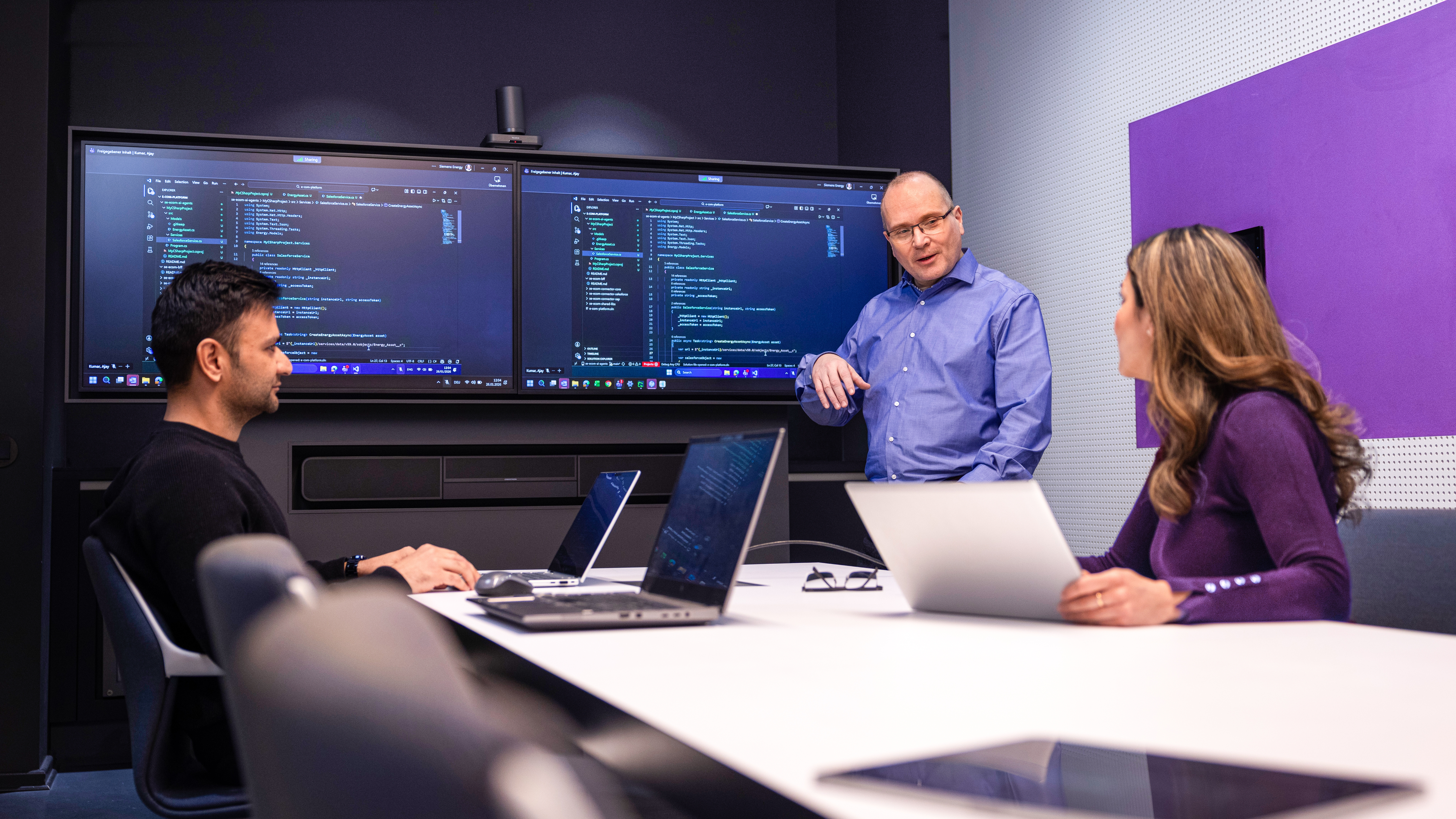
Transforming power generation with AI
As the energy sector navigates challenges such as surging demand, an aging workforce, and market volatility, digitalization and artificial intelligence are emerging as key drivers of a more efficient, secure, and reliable future. “AI and digital solutions can help power producers through optimization, automation, and really simplification of their operations,” says Omterra Product Manager Jason Voelker, who partners with producers across North America to understand their needs and leads engineering teams to develop solutions.
AI and digital solutions can help power producers through optimization, automation, and really simplification of their operations.
He points out that AI has already been deployed at power plants across the United States. Computer vision technology, for example, is enhancing plant monitoring at Wolf Hills Energy in Virginia. At the High Desert Power Plant in California, Omterra’s Managed Detection and Response (MDR) service is helping identify and address cyber threats while also alerting operators to early signs of equipment failure.
Several power plants are using Omterra’s Omnivise Energy Management software, which uses AI to optimize dispatch for profitability and sustainability. Additional AI-enabled technologies are on the horizon, as well, including robotics equipped with sensors that can detect anomalies outside of the normal human acoustic and visual ranges.
Computer vision monitoring
At Wolf Hills Energy in Virginia, a 250 MW natural gas power plant owned by Middle River Power, plant operators were seeking a solution that would enable them to optimize their staff resources and operational efficiency. Working with Omterra, they implemented a computer vision system that uses a network of cameras to monitor critical systems such as emissions control, fire protection, and turbine lube oil.
AI algorithms analyze data obtained from the cameras to automatically detect anomalies, leaks, and unsafe conditions. Unlike manual inspections, the computer vision solution provides consistent, real-time data streams to reduce operator variability and improve reliability.
“Any time a customer can identify an oncoming failure, the cost of preventative action is one-fifth the cost of taking action after a failure,” Voelker says. “The main driver for anomaly detection is to identify issues before they occur.”
Defending power plants against cyber threats
At the High Desert Power Plant, Middle River Power was seeking a solution that would address the increasing number of cyber threats to its operational technology. “These facilities use state-of-the-art control systems, and operators must protect those systems from any type of intrusion attempt to keep energy reliable.” says Dan Harmon, Vice President of Project Development at Middle River Power. “Any type of intrusion attempt could result in an outage affecting the entire grid.”
Any type of intrusion attempt could result in an outage affecting the entire grid.
Developing the necessary expertise to respond to today’s heightened threat environment would be too costly and time consuming for Middle River Power to take on alone, so it partnered with Omterra to implement the Managed Detection and Response (MDR) service.
AI-enhanced security and operational insight
MDR integrates and then analyzes data from several control systems from a range of vendors to provide a heightened level of security. Security analysts at Omterra review the notifications and alerts from the artificial intelligence system, determine whether anomalies require action, and alert plant operators as needed. The system has been effective in protecting against cyber threats and in identifying early signs of mechanical failure.
“One of the most meaningful and impactful outcomes that implementing Managed Detection and Response at High Desert accomplished was immediate visibility to all systems within their controls environment,” says Jonathan Tubb, Industrial Cyber Security Officer (ICSO), Gas Services, for Omterra North America. “And what that meant is suddenly they had the ability to diagnose, troubleshoot, and triage things that would have previously required somebody to physically sit in front of a device. It made them far more effective at detecting and responding to events.”
AI optimizes power plant dispatch
In addition to enhancing operational efficiency and security, AI can help plant operators optimize dispatch in an era defined by rapid growth in the use of mixed generation sources such as wind power, solar, and traditional gas turbines.
By combining energy system production models with AI-powered market and weather forecasting models, the Omnivise Energy Management solution enables plant operators to make data-driven decisions that maximize both economic performance and energy efficiency.
Measurable gains in efficiency and output
Voelker notes that the system has helped customers achieve single-digit percentage increases in efficiency and generation output. He adds that as plant operators gain confidence in the tool, they can choose to reduce the safety margins they apply when bidding into energy markets.
“Energy Management has been in very high demand and is expanding its functionality,” Voelker says. “According to the customer’s priorities, it will help balance and predict based on ambient conditions and forecasts, and then give the customer the best plan.”
Advancing toward autonomous power plants
The experts at Omterra are developing, testing, and deploying several new technologies that bring power plants closer to autonomous operations. Dynamic Virtual Plant Insider (DVPI) is a 3D virtual environment for robotic missions developed by Omterra. Using LiDAR scans or existing 3D models, the system creates a digital map of a facility.
Using this map as a guide, a dog-like robot with cameras and acoustic sensors autonomously walks through the facility and collects data. It can check gauge readings, inspect for leaks or spills, and detect equipment issues such as bearing failures or high-pressure system leaks. Several pilot programs worldwide are evaluating DVPI, and Voelker anticipates it will be commercially available in 2026.
“I have spent 25 years walking power plants under construction and imagining the types of solutions that are now starting to emerge.” Voelker says. “So, it’s very satisfying to participate in delivering those solutions to customers.”

If you don’t work towards digital maturity, you are going to be left behind.
Cybersecurity built into every AI solution
The range of digital and AI-enabled solutions Omterra offers have one thing in common: they are secure by design. Tubb explains that AI requires access to data, which necessitates interconnecting systems. Each new interconnection creates opportunities to optimize plant operations, but interconnections also create potential points of entry that an unauthorized user can exploit for malicious purposes.
“We are witnessing a rapid evolution in tools and technologies like artificial intelligence and machine learning,” Tubb says. “Keeping cybersecurity at the forefront of those efforts is going to be key to maintaining the stability of our grids, as well as not building technical debt for ourselves in five, 10, or 15 years. It’s much easier to integrate cybersecurity up front when you’re building and designing a system than it is to rebuild or redesign systems.”
Tailored digital strategies for every power producer
Alan Karr, Head of Digitalization CD for Omterra North America, notes that in addition to varying levels of technological adoption and readiness, energy producers have distinct needs and priorities. He emphasizes that rather than presenting customers with one-size-fits-all recommendations, Omterra partners with them to understand and address their unique challenges with targeted and tailored digital solutions.
“A lot of customers know where they want to be, but not how to get there,” Karr says. “We try to bridge those gaps by baselining and understanding where they are so we can help them on their journey.”
Starting small to drive lasting transformation
Voelker acknowledges that the range of digital and AI solutions available can make it difficult for power plant owners and operators to know where to begin. He advises beginning with high-impact, low-complexity tasks that demonstrate the value of digital solutions. As organizations build their capabilities and confidence, they can move on to more complex needs.
He emphasizes that competitive pressures and an aging workforce make digital transformation essential rather than optional. “The competition is moving forward,” Voelker says. “Every customer is at a different step in its digital maturity, but if they are not taking action then they are going to be left behind.”
About the author: Sameh Fahmy is an award-winning freelance technology and medical journalist based in Athens, Georgia, USA.